
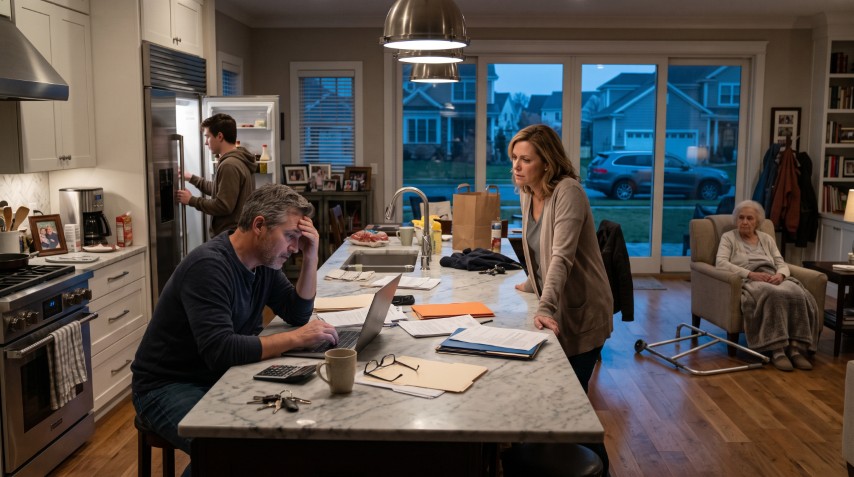
On paper, Generation X boasts some of the highest household incomes in the developed world. The old financial scripts promised that by our late forties and fifties, we would be aggressively paying down debt and watching our wealth quietly grow. The reality is not that. We are caught in a bizarre contradiction of high income and dangerously low liquidity. A relentless combination of inflation, skyrocketing housing and education costs, the sudden weight of elder care, and looming late-stage debt has us running just to stand still. And the cliff edge is getting closer.
Economists call this the wealthy hand-to-mouth phenomenon. The traditional assumption was that living hand-to-mouth meant low wages and an empty bank account. Modern modeling reveals a more complicated trap. Many of our households are undeniably wealthy on paper. We have substantial assets locked up in primary residences and preserved retirement accounts. Yet we hold virtually no cash reserves. The modern economy actively encourages this high-wire act. Illiquid assets like real estate and superannuation offer tax breaks and compounding returns, but accessing that money comes with punishing friction. When a sudden expense hits, we cannot simply sell a bedroom. We reach for expensive credit instead. If a tax refund actually materialises, it never sees a savings account. It vanishes instantly into credit card balances or deferred school fees.
The engine behind this cash drought is a historic spike in the cost of living that struck precisely during our peak earning years. This inflation is uniquely brutal because it targets the non-discretionary. You can skip a family holiday, but you cannot opt out of a roof or a school. Housing is the grand monument to this crisis. Baby Boomers bought into a market characterized by high interest rates but low principal, and their debt was eventually washed away by rampant inflation and rising wages. We bought into a market of falling rates and astronomical purchase prices. That forced us into highly leveraged positions where household debt often exceeds four hundred percent of our income. Boomers peaked at around forty-five percent. We are not fleeing to the fringes either. We are heavily mortgaging established homes in middle-ring suburbs to fund the renovations needed for multi-generational living.
This is exactly why we became the sandwich generation. We carry the dual burden of housing our adult children and subsidising the care of our aging parents, and both require massive amounts of cash. Our kids are staying home longer because they face the exact same housing crisis and inflated education costs. Our parents require escalating healthcare and daily assistance. In Australia alone, women aged forty-five to sixty-five quietly prop up a $77.9 billion unpaid care economy. Meanwhile, the promised Great Wealth Transfer is proving to be a mirage. Much of that theoretical inheritance will be swallowed by long-term medical care or pass horizontally to a surviving spouse. By the time any remnants filter down to us, it will be decades too late to help with our peak mortgage or child-rearing years.
The financial strain is compounded by a localised arms race in education. In Australia, the cost of an independent private education has surged past $400,000 per child. For a family with two kids, funding nearly a million dollars in post-tax fees obliterates any chance of building liquid savings outside of mandatory superannuation. When those kids reach university age, the burden simply changes shape. Across the English-speaking world, tertiary education has hyper-inflated. The average time to repay a HECS loan in Australia is nearly ten years, forcing parents to subsidise daily living expenses. The situation in the United States is more severe, where high-earning parents are pushed into federal Parent PLUS loans carrying punitive fixed interest rates that demand immediate repayment. Even in New Zealand, where domestic students get interest-free loans, the diaspora facing compounding overseas interest often requires a parental bailout just to avoid defaulting.
All of this creates a highly precarious position as we approach our final working decades. Carrying massive debt into your fifties exposes a household to structural vulnerabilities. The traditional advice from financial planners is to shift asset allocations from volatile equities to stable bonds as retirement nears. We face an impossible conundrum instead. Because our daily liquidity has been drained for decades, our retirement vehicles are often underfunded. To hit the required targets, we must maintain aggressive, equity-heavy portfolios well into our late fifties. We mathematically cannot afford to reduce our risk. Yet maintaining full exposure to the stock market while carrying high debt is precisely what will trigger a catastrophic sequence of returns failure if the market crashes.
That specific financial risk assumes we even get to keep our jobs. Just as our financial obligations hit their absolute peak, our generation is facing a quiet, systematic wave of redundancy. The corporate world is actively dismantling the middle-management layer where so many of us reside. Algorithmic efficiency and the rapid integration of artificial intelligence are turning our decades of experience into an expensive liability on a spreadsheet. We are being optimized out of existence, replaced by younger, cheaper talent or software agents that do not ask for a pension. When a fifty-something professional is managed out today, they rarely face human judgment in their job hunt. They face an applicant tracking system that views twenty-five years of loyalty not as stability, but as a lack of agility. Losing a peak salary at this exact moment in the economic cycle is a mathematical disaster.
The resulting picture is one of profound economic entrapment. We are wealthy on paper and exhausted in reality. Without a fundamental restructuring of housing supply, aged care, and education costs, millions of us will be forced to push our retirement into our late sixties or seventies. We are bound entirely by a system that demands we keep running simply to stand still, all while hoping the algorithm does not suddenly decide to turn off the treadmill.