The blur between social democracy and socialism
I constantly hear the word socialism used when people are in fact talking about social democracy. This article clarifies what each system is. From there, it is up to you to decide your own thoughts.
Socialism is an economic system that demands the state take total ownership of a nation's main assets to eradicate the pursuit of private profit.
Social Democracy leaves the mechanics of capitalism in private hands but uses taxation and regulations to invest in human capital, such as health, education and research.
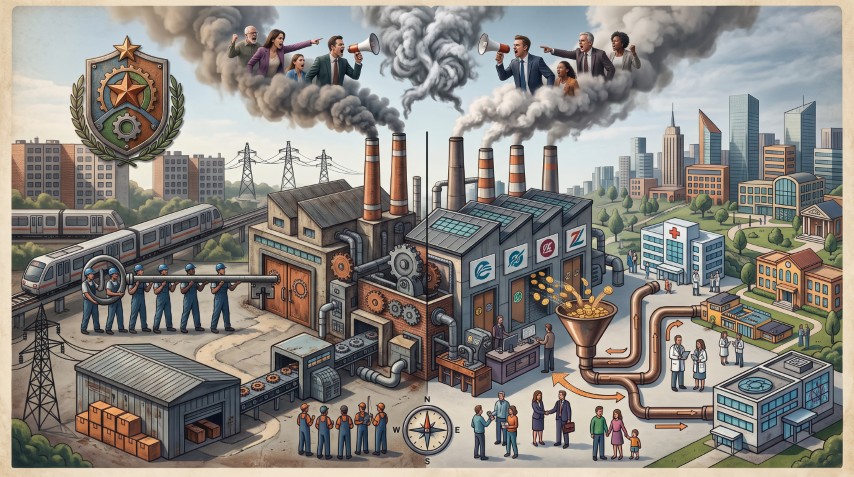
To untangle socialism from social democracy, you only need to ask who holds the keys to the factory. True socialism dictates that the state or the public must own the main assets of the economy, replacing private enterprise with collective control. Social democracy operates on an entirely different premise by leaving property, corporate assets and the raw power of market efficiency firmly in private hands. It does not seek to abolish capitalism. Instead, social democracy relies on a robust democratic system to set the rules for the economy, taxing the immense wealth generated by private enterprise and redistributing it through strict regulation and a vast public safety net.
The American Paradox
The United States considers itself the ultimate champion of free-market capitalism, yet its historical trajectory of greatness (MAGA) is deeply tied to social democratic ideals. Following the Second World War, the American government deployed public capital to assume the ultimate economic risks. Through national science policy blueprints, the state funded the foundational, high-risk research that eventually birthed the digital age, modern aerospace and biotechnology. Taxpayers covered the expensive early risks of creating new technology, while private businesses were allowed to keep the final products and the financial rewards.
During the 1940s and 1950s, the United States also operated under a system featuring highly progressive taxation, strict financial regulation and robust unions. The gains of economic growth were distributed widely across the income spectrum. Beginning in the late 1970s, a deliberate shift dismantled these social democratic buffers. The country slashed top marginal tax rates, weakened labor power and prioritised shareholder returns. This move away from social democratic ideals created a wealth divide, which becomes obvious when we look at where America sits on the global stage.
The United States ranks second in the world with an average, or mean, wealth of $696,277 per adult. Yet when examining the median wealth, which represents the exact middle of the population, the nation plummets to twenty-eighth globally at a mere $68,998. Compare this to Australia who maintain mechanisms like robust minimum wages and compulsory retirement savings, Australia ranks fifth globally in average wealth at $616,306, but it secures the third highest median wealth in the world at $210,783. The massive gap in the American figures shows that while the United States economy generates vast wealth, the mechanisms to distribute that wealth broadly don't seem to be working. Currently the result is a much lower standard of living for the median American worker compared to nations that maintained their safety nets.
The Nordic Example
If you want to see social democracy functioning by the book, you look to the Nordic model. Countries like Sweden, Norway and Denmark are frequently mislabelled as socialist in popular discourse. In reality, they are highly competitive capitalist economies that pair free markets with expansive social welfare programs. These nations fiercely protect private property rights and promote free trade. They simply choose to levy high taxes to fund universal healthcare, free higher education and robust safety nets.
This synthesis of market flexibility and profound human security is likely why Nordic countries consistently score at the top of the global Human Development Index. They show that a nation can achieve an incredibly high standard of living by preserving the capitalist engine while regulating its distributional outcomes. This stands in stark contrast to strictly state-controlled socialist economies, which historically suffered from severe stagnation and failed to produce long-term prosperity.
The Political Name Game
Despite these glaring structural differences, politicians across the English-speaking world constantly mix up the terms. The confusion is often deliberate, used as a rhetorical weapon or a populist branding tool. In the United States, populist politicians frequently weaponise the term against moderate opponents, branding them as radical socialists to blend basic social safety nets with a Marxist takeover. We see the exact same theatre in Australia, where politicians like Peter Dutton and Scott Morrison have accused the Labor Party of pushing a socialist agenda, completely ignoring the fact that Labor whether you agree with them or not does in fact run within a capitalist framework. The irony continues in the United Kingdom, where conservative leader Rishi Sunak recently accused his own party colleague, Liz Truss, of promoting socialism simply because she proposed tax cuts.
Words matter. When we conflate a system that abolishes private property with a system that simply taxes private property to spend more on schools and hospitals, we lose the ability to have a rational debate about our economic future. There is certainly an argument that heavy taxes required to fund a vast safety net inevitably create severe deadweight losses, disincentivise hard work and ultimately suffocate the long-term economic growth needed to generate wealth in the first place. That is an entirely valid debate to have about the limits of social democracy.
Yet, understanding that debate requires getting the definitions right first. The United States was at its most broadly prosperous when it embraced the collective, social democratic ideals of shared risk and shared reward. This is not to say that the way to return to that prosperity is to embrace social democracy, or that social democracy is definitively the right way to go. The question is do we want to continue letting political theatre obscure the economic arguments that may build a strong middle class, rather than relying on emotional and inaccurate arguments that do not effectively progress any ideal?