
Stop the Burnout: Energy Hacks for Gen X
The Reality Bite
We built a fortress of self-reliance and wore our cynicism like armour to figure things out alone. But here is the kicker: that fierce independence is now wrecking us.
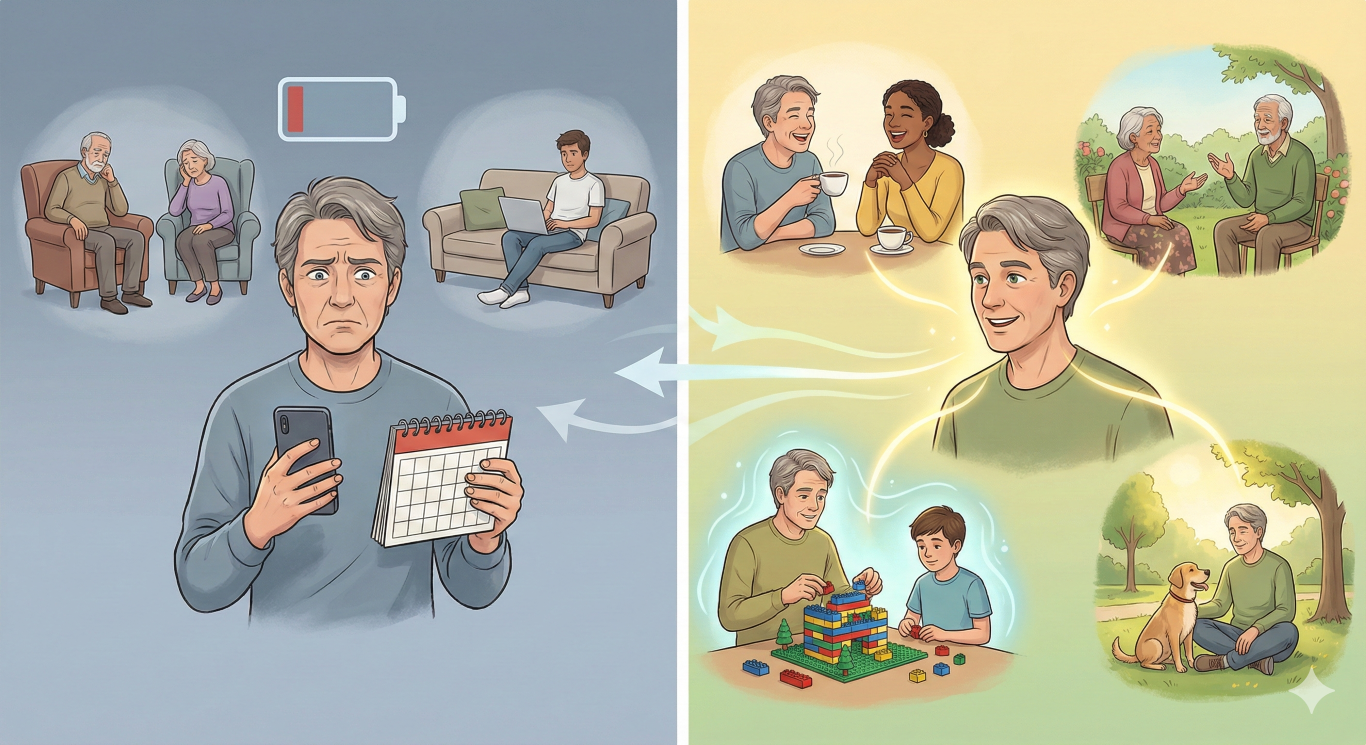
Anxiety rates are skyrocketing because we are trying to manage over 50 hours of caregiving a week on top of our actual jobs. We are running on fumes, treating our energy like a dying battery that just needs a nap to recharge. But the science says we are doing it all wrong.
You Are Not a Battery
Most of us think energy is a finite tank: you use it, it empties, you sleep, it fills up. But researchers found something cooler called "Relational Energy". This is not about calories or sleep; it is about interactions that actually boost your capacity to get things done.
Think about it. When you hang out with a "positive energizer," you leave feeling ready to take on the world. This energy is renewable. The problem is our "I can do it myself" attitude. It triggers "metabolic hoarding," where our brains burn extra fuel just preparing to handle threats alone. We are literally exhausting ourselves by refusing to share the load.
Upstream: Handling the Boomers
Let's talk about our parents. Managing their decline is often a mix of medical chaos and role reversal that drains us dry. But you can flip the script.
First, stop fighting them on safety issues like driving. You will lose, and you will be exhausted. Instead, use the "White Coat" authority transfer. If your dad shouldn't drive, don't be the bad guy. Let the doctor be the bad guy. Tell him, "I'd love for you to drive, but Dr. Reynolds said it's a hard no for safety". You stay the ally; the doctor takes the heat.
Second, use their stories. Research shows that older adults get a huge boost from passing down wisdom. Conduct a "Resilience Interview". Ask them how they handled inflation in the 70s or lost jobs in the 80s. It makes them feel competent instead of like a patient, and it reminds you that your family has survived hard times before.
Downstream: The Failure to Launch
Then there are the kids. We love them, but the "failure to launch" dynamic is real. Supporting adult children is a massive financial and emotional drain that threatens our own future security.
We need to stop being "servants" and start running a co-op. If they live there, they pay "membership dues" in the form of chores. It is not helping mom or dad; it is contributing to the household community.
Also, stop trying to connect through face-to-face interrogation. It scares them. Use "parallel play" instead. Build a complex Lego set, cook a weird recipe, or just sit in the same room while they game. It creates a "flow state" where brains sync up and stress drops without the pressure of a deep conversation.
The Mechanics of Connection
If you want to stop bleeding energy, you need to plug the leaks. One massive leak is how we respond to good news. We are often so tired that when our kid or partner shares something good, we just mumble "that's nice" while checking email. This is a "Passive Constructive" response, and it kills connection.
Try "Active Constructive Responding" (ACR) instead. It takes two minutes. Put the phone down, make eye contact, and ask enthusiastic questions like, "Wow! How did you feel when that happened?". It gives you both a dopamine hit and builds a buffer against future stress.
Reclaim Your Sovereignty
It is time to drop the martyr act because it is leading us straight into resentment and isolation. Guilt is our generational Kryptonite, making us believe that setting boundaries is the same as abandonment. But you cannot pour from an empty cup. Taking a break is not a luxury; it is a medical necessity to prevent a total crash.
To fix the leaks, take a hard look at your daily routine to see where your power is actually going. Pinpoint the specific interactions that drain you dry. If the morning rush is a nightmare, find a way to automate or delegate it immediately. Conversely, if walking the dog restores your sanity, you must prioritize and protect that time from intrusion.
The goal is to shift from our default setting of hyper-independence to a sustainable model of interdependence. We do not have to survive in a "bunker mentality" anymore. By finally giving ourselves permission to share the load, we can transform our homes from sites of depletion into reservoirs of renewable life.