
Clear The Clutter To Save Your Future
We are the pivot point. While the generations before us held onto everything and the kids coming up own nothing but a subscription to the cloud, we are stuck right in the middle. We are the "Caretaker Consumers," spending more annually than any other generation as we support aging parents and launch our own kids.
Our homes have become warehouses of unmade decisions. But here is the reality check: keeping all that stuff is not just annoying. It is actively sabotaging our finances, our mental health, and our future freedom.
The Cortisol Cocktail
Let’s be honest about the stress. We are already dealing with the "sandwich generation" squeeze, and our physical environment is making it worse. Research shows a direct link between a cluttered home and high levels of cortisol, the stress hormone.
Visual Noise: Piles of mail and overflowing closets create "visual noise" that drains our cognitive resources.
The Hormone Factor: For the women in our cohort, perimenopause and menopause can mess with executive function, creating "brain fog". A chaotic house makes navigating this biological shift exponentially harder.
Regaining Control: Organizing our space is a way to hack our biology. It acts as a form of "environmental hormone replacement therapy" by reducing the demand on our brains.
The "Brown Furniture" Lie
We were raised to believe that heavy wood furniture and "collectibles" were safe investments. That belief is now obsolete. The secondary market for what the industry calls "brown furniture" (that mahogany dining set from Mom) has collapsed, with values dropping by 70 to 80 percent.
Younger generations do not want it. They prefer modern, sustainable, or lighter furniture that fits into smaller urban apartments.
The Liability: Holding onto these items hoping for a windfall is a financial trap. You are effectively hoarding liabilities.
The Storage Trap: If you are renting a storage unit for $150 a month, that is money hemorrhaging from your retirement fund. Over 20 years, that money invested could have grown to nearly $60,000.
The Reality: The smartest financial move is often to sell it for pennies on the dollar or donate it now to stop the "rent" these objects are charging you.
The 10-Year Physical Window
This is the part nobody likes to talk about, but we must. We are currently in a strategic window of physical capability that will likely close in 10 to 15 years. Right now, we are strong enough to lift boxes and haul debris.
If we wait until our 60s or 70s, orthopedic issues like bad knees and hips will make this level of work impossible.
Beat the Clock: We have about a decade to handle the heavy lifting. Waiting forces the burden onto our children or requires expensive hired help later.
Safety First: Clearing pathways now prevents falls later, which are a leading cause of injury for older adults. We are future-proofing our homes so we can age in place safely.
Stop the Trauma Cycle
Many of us are currently traumatized by clearing out our parents' hoarded homes. It is months of labor and guilt. We have a unique chance to break that cycle so our kids do not inherit the same burden.
Gen Z values experiences over things. They do not want the china sets or the figurines. By decluttering now, we are role-modeling a new form of stewardship that values the mental health of the living over the preservation of dusty objects.
The Analog-to-Digital Bridge
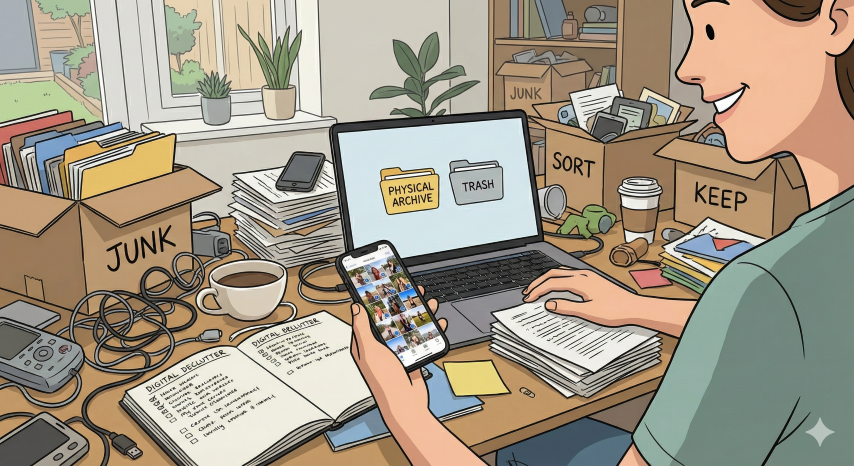
We are the last generation with an analog childhood and the first with a digital adulthood. Our history is heavy because it is printed on paper.
Save the Memories: We possess the last great physical archive of family history. Scanning these photos allows us to throw away the bulky, moldy boxes while securing the memories in the cloud where our kids might actually see them.
Swedish Death Cleaning: This isn't morbid; it's practical. This method focuses on legacy and asks, "Will this item be a burden to my loved ones?".
The Pivot
Decluttering is not just about cleaning up. It is about regaining agency in a chaotic world. It lowers our stress, secures our finances, and protects our kids. The window to act is open, but it is closing fast. Let's dump the junk and reclaim our "Second Act".