
Is Australia Fooling Itself at the Ballot Box?
If there is a unifying belief among Generation X, it might well be a preference for being left alone. One might wonder, then, how the concept of compulsory voting fits into this worldview. Is it a relic of a bygone era? Is it something that manufactures “engagement” through the petty threat of a fine? It seems natural to approach this with suspicion. Curiously, however, some seventy per cent of Gen X Australians express support for it.
We are left with a fascinating contradiction. Can those who argue that compulsory voting produces democracy simultaneously deny that the freedom to say "no, thank you" is an essential part of that very concept?
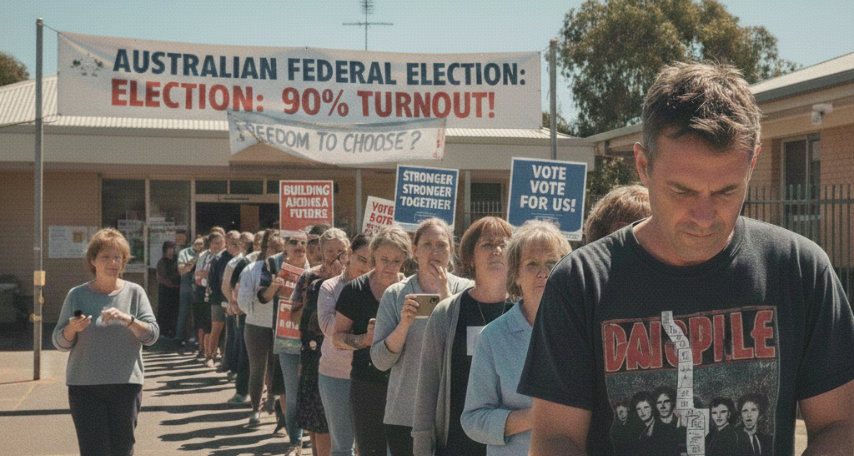
Australia boasts a ninety-per-cent turnout at the polls, but we must ask ourselves a difficult question. Does mere physical attendance equate to a healthy, functioning society? Furthermore, is it possible that by dragging unwilling people to the polls, we are actually corroding democracy?
The Right to Remain Silent
Democracy is predicated on choice. If one possesses the right to speak, does one not fundamentally possess the right to remain silent? If one has the right to assemble, should one not retain the right to walk away? We must consider whether forcing someone to cast a ballot is essentially demanding they offer a stamp of approval to a system or a slate of candidates that they may find entirely objectionable.
In the Australian system, absenteeism is met with a fine arriving quietly in the mail. It is, by all measures, a victimless crime. Yet, this political inactivity is prosecuted like a traffic violation. It is often argued that voting is a civic duty, just like paying taxes or reporting for jury service, but does this comparison hold up under scrutiny? Taxes build the physical infrastructure we rely upon, and juries are a mechanical necessity of the justice system. Voting is an act of deeply personal expression.
When expression is legally coerced, does it retain its authenticity, or does it become mere acting? By making voting a legal obligation, is the state effectively declaring silence illegal?
The Donkey Vote and the Alphabet
When millions of uninterested people are legally compelled to vote, the inevitable result is the Australian "donkey vote." Irritated voters simply number their ballots from top to bottom just to evade a penalty. This transforms the genuine selection of a leader into the mere completion of paperwork.
What does it mean for our electoral integrity when a tiny margin of careless votes can decide who runs the country? Are we essentially allowing a coin toss to dictate the national budget? While ballot orders are now frequently randomized to prevent parties from exploiting this apathy, the question remains. Are we actively diluting our democratic mandate with the random scribbles of the forced voter?
The Democracy Sausage: Civic Duty as Cultural Ritual
Why do Australians tolerate this? To find the answer, perhaps we should look past political science and peer inside the local school gymnasiums where voting actually happens. Has compulsory voting shifted from a democratic necessity into a mere cultural habit? Do we defend it out of a genuine belief in forced participation, or simply because we enjoy the shared routine?
Election day in Australia is famously a social event. The "democracy sausage" acts as the unofficial mascot of the whole process. It is just a simple sausage on white bread, bought to support a local community fundraiser.
Does this festive atmosphere of bake sales and good-natured grumbling bind the public in a way that transcends politics? It is perhaps the only day of the year when an entire neighbourhood is forced to gather in one place. Seen in this light, the overwhelming support for the mandate invites a blunt question. Does the institution survive simply because ending it would ruin a beloved Saturday ritual? Are we ultimately tolerating government overreach just for the sake of a good barbecue?
Lazy Politicians and the Slogan Machine
What is the effect of mandatory voting on politicians? In a voluntary system, a candidate must perform the hard work of convincing the electorate to leave their homes. They must inspire the public, present a compelling vision, and demonstrate their worth.
In a compulsory system, politicians tend to operate with the luxury of a captive audience. Does this breed complacency? We see campaigns abandon policy depth in favour of scare campaigns and repetitive, three-word slogans. If strategists are battling solely for the vote of swing voters who are paying the least attention, is the message not eternally rooted to the lowest possible denominator?
| Democratic Framework | Compulsory System (Captive Audience) | Voluntary System (Earned Audience) |
|---|---|---|
| Campaign Style | Tends toward slogans and soundbites | Requires policy depth and motivation |
| Strategic Focus | Frightening the middle ground | Inspiring the base and persuading the center |
| Candidate Effort | Lower (Turnout is a legal guarantee) | Higher (Turnout must be earned) |
| Potential Result | Complacent politics | Genuine engagement |
Consider New Zealand or the Scandinavian nations. They do not force voting upon their electorates, yet their turnout frequently eclipses eighty per cent. Why is this the case? Is it because their politicians are forced to work relentlessly to engage the public, publishing comprehensive manifestos because they know the public will not show up otherwise? Does it turn out that when a state treats its voters like adults, they tend to behave like them?
The Illusion of Engagement
We are all familiar with the triumphant headlines heralding record turnout after an election. We like to pat ourselves on the back, but are we operating under the delusion that a high turnout is the same as a satisfied public?
Can you force someone to visit an art gallery and then expect them to love art? The data suggests that residing in a mandatory system does not magically produce politically literate citizens. In fact, because there is an assumption that people must engage, does this mandate actually foster political illiteracy?
Furthermore, does mandatory voting create a structural blind spot in the form of the safe seat? In a voluntary system, if a representative ignores their base, the base stays home. In Australia, however, people in safe seats are legally required to show up and vote for their party regardless of how thoroughly they have been neglected. Does this not permit the major parties to essentially ignore vast segments of the population, funneling all their money into a handful of swing electorates?
A Final Note
Ultimately, is a robust democracy not one that people actively wish to participate in? If a government is incapable of persuading its people to sacrifice twenty minutes of their Saturday to cast a ballot, is the failure not the government's rather than the people's?
We have spent our lives navigating systems designed to box us in. Perhaps we do not need a federal mandate demanding our presence at the polls. What if, instead, we need ideas and leaders that make us want to be there? And if, in the absence of a fine, the polling stations sit empty, should we not possess the courage to ask why and then resolve to fix it?