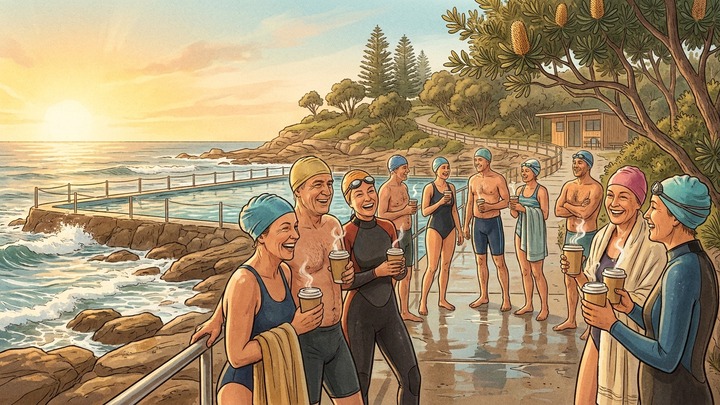
At six in the morning on a coastal beach, a dozen people in rubber caps finish a half-mile swim and gather around an espresso cart. During business hours, the cluster includes a commercial litigator, an architect, and a deputy principal. In the car park, nobody mentions interest rates or quarterly targets. They talk with a familiarity that none of them has experienced in an office for sometime. They have found what the sociologist Ray Oldenburg called a "third place" which is a neutral ground outside home and work where status is levelled and conversation is the main event.
For much of the twentieth century, those spaces were obvious. the bowling green, the parish hall, the corner pub. Over the past two decades, however, traditional clubs have either lost membership or mutated into high-margin hospitality venues dominated by poker machines and QR-code menus.
This contraction has hit Generation X with peculiar force. Roughly one in three Australian adults now reports measurable loneliness, with Generation X logging some of the lowest hours of informal face-to-face socialising. For those with children finishing secondary school, the conscripted community of Saturday morning sideline sport evaporates. Meanwhile, workplace seniority turns office relationships transactional, and hybrid work has collapsed home and career into a single domestic-corporate zone, eliminating the unscheduled Friday drink.
The physiological cost is steep. Chronic social disconnection increases the risk of premature mortality by nearly thirty per cent, a toll equivalent to smoking fifteen cigarettes a day. Disconnected professionals exhibit elevated evening cortisol, systemic inflammation, and fractured sleep. You cannot biohack your way out of isolation with a smartwatch and a magnesium supplement.
Members of Generation X have long hated the contrived networking evening. Instead, many are building a new structure for belonging that centers on shared physical effort and practical service. More than twelve hundred Men's Sheds now operate nationwide. These spaces sit alongside a growing wave of urban Women's Sheds, tool libraries, and weekend repair cafes where membership has steadily expanded from retirees to working professionals. For someone who spends fifty hours a week manipulating spreadsheets, dedicating four hours on a Saturday to planning recycled hardwood next to a retired boilermaker offers profound sensory relief. Psychologists refer to this as adult parallel play. People suffering from decision fatigue simply bond more naturally while working shoulder to shoulder on a concrete task than they do sitting nose to nose across a cafe table.
A similar dynamic drives the boom in environmental groups and communal fitness. Thousands of suburban residents spend their weekends in local Bushcare groups, pulling invasive lantana and replanting urban creek beds. Even exercise has migrated from the headphone-sealed commercial gym to the secular parish of the Saturday morning Parkrun, where the post-run coffee is treated as the main event.
Sustaining these spaces requires overcoming both commercial pressures and administrative friction. High rents have pushed community groups off main streets, making public spaces like libraries and gardens more important than ever. However, strict rules and red tape are making it incredibly hard for these local projects to survive. Because formal volunteering has struggled to recover since the pandemic, the smartest clubs now tap professional skills through modular micro-volunteering and one-Sunday-a-month working bees rather than open-ended committee sentences.
Reclaiming a life beyond the corporate treadmill does not require dropping out of the economy, It simply asks how we allocate the margins of our week. When a professional trades an hour of scrolling property listings for an ocean swim, a morning in a timber shed, or a shift clearing a local reserve, the benefit is not merely philanthropic. It is an act of physiological and civic self-preservation.