
There is perhaps no more spectacular a start to a night of theatre than a clear evening walk to the Sydney Opera House. With the Harbour Bridge illuminated against the night sky and the energy moving through the crowds along the water, the approach itself sets an impossibly high bar. Inside the venue’s Drama Theatre, the Sydney Theatre Company has mounted Housework, a new political satire written by Emily Steel and directed by Shannon Rush. The production, originally commissioned by the State Theatre Company South Australia, attempts to condense the complex ploys and strategies of the Australian Parliament into a frantic two-hour examination of ambition, morality, and systemic exploitation.
The premise centres on Ruth Mandour, a newly elected federal MP attempting to push forward a bill that would mandate female representation in medical trials. To secure the necessary legislative backing, Ruth must rely on her hardened Chief of Staff, Anna Cooper, and a remarkably naïve junior staffer named Kelly Sheppard to win over the right ministers. Naturally after some after-work shenanigans, a staffer is compromised, igniting an explosive scandal. As journalists and opposition factions circle the ensuing wreckage, the women are forced to confront their buried pasts and decide whether to weaponise the truth for political leverage or risk their careers to expose an inherently predatory system.
Steel’s script is ambitious, tackling everything from workplace toxicity to the grey areas of political manoeuvring. Despite the weighty subject matter, comedic beats are sprinkled generously throughout the dialogue. The jokes often arrive in unexpected places and genuinely succeed in drawing smiles from the audience. Yet, the central notion leaves a lingering question. The title itself, Housework, never quite connects to the unfolding drama, remaining an enigma that the script refuses to clarify.
The ensemble cast bears the heavy lifting of the narrative with mixed results. Susie Youssef is excellent as the first-time MP. She settles into the role with a natural cadence and captures the precise anxiety of a woman trying to hold onto her ideals in a cynical ecosystem. Emily Taheny delivers exactly the performance required of the cynical Chief of Staff, anchoring the political maneuvering with hardened pragmatism. However, the chemistry between Taheny and Youssef misses the mark, leaving their critical partnership feeling somewhat hollow. Johnny Nasser turns in a solid performance as Paul, the calculating Minister for Science and the Environment.
Other performances seem to suffer under misguided direction. Franca Lafosse, playing the junior staffer Kelly, spends much of the play delivering a highly exaggerated, overly ditzy performance that borders on overacting. When the script finally allows her to drop the caricature in the later, heavier scenes, she proves herself to be a capable actor. A different directorial tone early on would have yielded a far more cohesive character arc. Similarly, Laurence Boxhall plays the media advisor Ben with sharp precision, but he is undermined by sloppy staging decisions. The primary cast is periodically required to double up as members of the opposition. Boxhall’s transition into this secondary role involves donning a strange pair of glasses and changing the pitch of his voice to an annoying register, pulling the audience entirely out of the moment. Furthermore, casting the iconic Indira Naidoo in a trifecta of roles (the Prime Minister, a cleaner, and a waitress) feels like a missed opportunity. She executes the parts well, but her presence is noticeably underutilized.
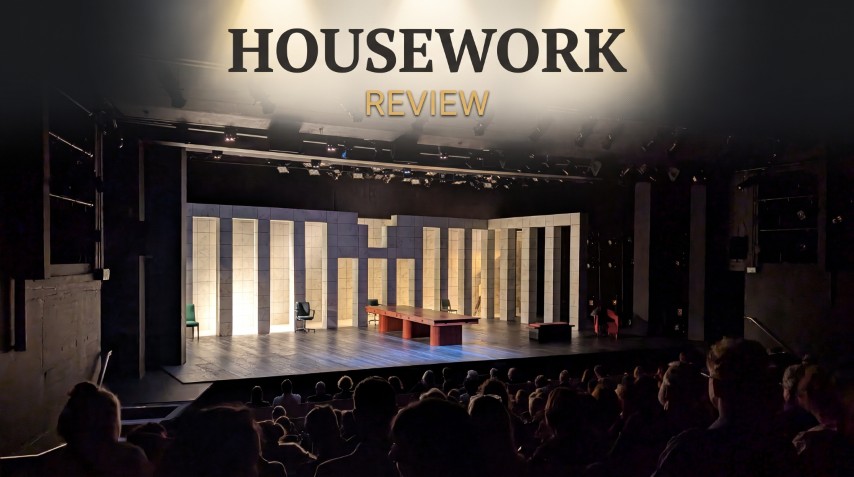
The production design also struggles to match the needs of the narrative. Considerable effort was clearly made to replicate the grand, imposing architecture of Canberra. While the stage looks undeniably smart at first glance, the sweeping parliamentary backdrop works against the script. The vast majority of the play’s scenes unfold in intimate, claustrophobic spaces like small offices and private hotel rooms. Placing these deeply personal exchanges against a cavernous political façade strips the dialogue of its necessary intimacy. This mismatch in scale is exacerbated by the technical elements. Sydney theatregoers have grown accustomed to exceptional light and sound design, but this production falls short of that standard. The lighting is strangely bland, lacking the nuance required to shift the mood, and the sound effects are executed poorly.
The thematic scope of Housework is undeniably compelling. The creative team simply attempts to cram too many disparate issues into a small window, stretching the two-hour runtime thin across too many ideological battles.
It is a peculiar experience to recognise so many structural and technical flaws while still walking away satisfied. Despite the misfires in direction, the clumsy double-casting, and the disconnect between the set and the story, the overarching experience remains a positive one. Housework is an enjoyable, thought-provoking piece of theatre that earns a recommendation. It may not be the flawless masterpiece you anchor an entire weekend around, but it serves as an excellent weekday excursion, providing enough wit and intrigue to give you a lively spark for the morning ahead.