We arrived at Carriageworks late, waiting for a severe weather front to pass. We also knew our aging legs and backs were ill-equipped for a standing-only festival, but the line-up for Move My Way was simply too good to ignore. Securing a parking spot near the venue is always a gamble with no viable booked options nearby. Managing to find street parking ended up being easy, although it is worth noting that public transport makes reaching Carriageworks exceptionally easy. Security was a breeze. Walking inside, we joined a vast collective of people drawn to the festival for wildly different musical reasons.
The venue was split across three distinct areas. The main stage was dubbed Over Here, while the outdoor setup was named Over There, leaving the smaller Planet Trip room tucked away inside. A gauntlet of bars and food stalls lined the exterior spaces. Drink options were plentiful, but the organisers underestimated the crowd's need for food.
The site was still reeling from the recent storm. Things were running roughly thirty minutes behind on the main stage and even later outdoors. We logically assumed they would make up the lost time by compressing the DJ sets between live acts. We were profoundly disappointed to find that no such logic was applied. Communication regarding the shifting schedule was non-existent. The venue occasionally flashed adjusted times on the performance screens, but these were largely invisible to the crowd.
Our initial plan was to catch Kokoroko, Takuya Nakamura, and Ezra Collective. Thanks to the disorganised scheduling, we ended up enduring entirely too much of Freddie Gibbs.
Fortunately, the early acts provided a solid foundation for the evening. We caught a vibrant set by Jamz Supernova. The South East London broadcaster and DJ is known for blending global bass and funky rhythms, and she kept the transitional energy high. Kokoroko followed and was an absolute joy. A London-based septet rooted in West African highlife and afrobeats, they brought a collective energy to the room. Every member seemed talented, effortlessly trading vocal duties while mastering an array of wind and string instruments. The crowd was swept up in their performance, making it a perfect start to the live acts.
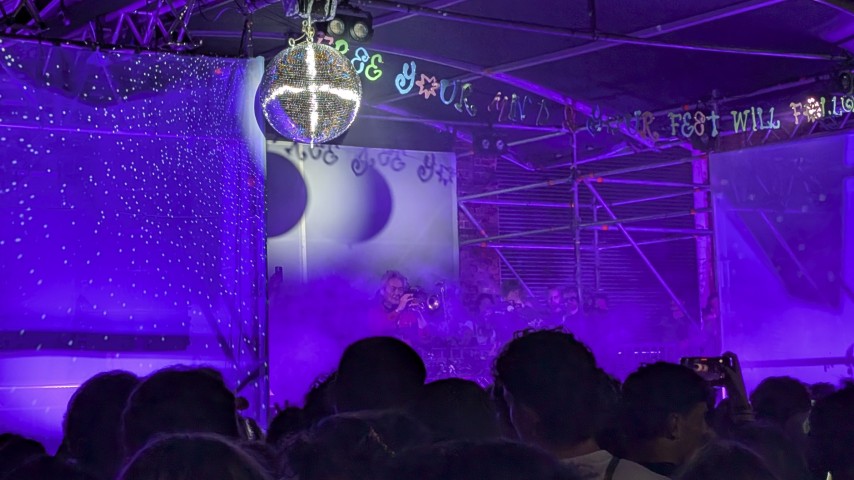
Wandering the grounds, we stopped briefly in the Planet Trip room to see La Foxy Fuzz. The Colombian-born DJ was spinning an infectious selection of funky house tunes. The room itself was a much smaller, uniform space with great sound quality. Oversized beanbags were scattered around the perimeter, and a dense layer of fog hung in the air. The atmosphere certainly lived up to the Planet Trip label's name, though a bit more stage lighting would have improved the visual experience. Curiously, this room attracted attention from the police :-). We never witnessed a single instance of bad behaviour or any situation requiring police intervention, so their lingering presence felt assuring but oddly misplaced.
We headed back to the Over There outside stage and caught the tail end of a set by South London DJ Tash LC. She delivered a brilliant mix of afrobeat, jungle, and club music. The outside stage has to compete with the elements and the noise of passing trains, but the sound quality was excellent, and watching the trains roll past actually added a cool, industrial charm to the space.
DJ Tash served as a perfect primer for Takuya Nakamura. Originally from Japan and now a staple of the Brooklyn music scene, Nakamura is a proud member of Generation X. He carries a deeply infectious, lovable aura, performing with a uniquely modest and relaxed physical presence. He started his set slowly with jazz house grooves before building into a relentless rhythm of techno and jungle. His mixing between tracks was not entirely fluid, but it was incredibly effective. I found myself constantly anticipating what the next drop would bring.
We left Nakamura early to secure a good spot for the night's main event, London's Mercury Prize-winning Ezra Collective. This proved to be a spectacular mistake. Because the main Over Here stage was running so far behind, we arrived right in the middle of a set by American rapper Freddie Gibbs. We found his performance entirely uninspiring. Operating as a one-man show, his delivery felt monotonous and repetitive. The irritation grew as it became clear he was eating into the venue's strict curfew. The main attraction was inevitably going to be cut short because Gibbs ran overtime.
The sound quality at the Over Here stage did not help matters. It handled rap music adequately. However, when complex, multi-instrumental sounds were flowing, the mix was merely acceptable and heavily dependent on where you stood in the room. The lighting for a feature stage was similarly lacking, relying entirely on large screens to create any visual effect.
By the time Gibbs finally finished, we were relieved but not happy that Ezra Collective would face a compressed set. The atmosphere in the room transformed instantly. The lingering Freddie Gibbs fans filtered out, and the Ezra Collective crowd took over, shifting the mood from aggressive tension to a joyful readiness to party.
The London five-piece emerged with massive energy, instantly matching the anticipation of the packed floor. Their signature fusion of jazz, hip-hop, and afrobeat had everyone moving from the first note. Yet it was painfully obvious that the band knew they were up against a ticking clock. Having seen them perform the previous year, I could tell they felt rushed. They were unable to settle into their expansive solos or let the songs breathe the way they normally do. Despite this frustrating limitation, they still managed to put on a hell of a show and easily remained the highlight of the festival.
Exiting Carriageworks was straightforward, and the crowd remained in great spirits. We took a moment to appreciate the Over There stage on the way out.
If Move My Way intends to return to Sydney, the organisers need to sort out their logistical operations. A festival must manage its timeline effectively and find a way to communicate changes to the crowd. People buy tickets to see the headline acts, and those performances should never be sacrificed to a poorly managed schedule.