
Patra is frequently treated as a mere thoroughfare by travelers rushing toward the Ionian islands. Yet dismissing Greece's third-largest urban center is a mistake. With a population surpassing two hundred thousand, the city pulses with a distinct and self-reliant energy. It is a lively university town renowned for its legendary spring carnival, a place where expansive neoclassical squares spill into a bustling waterfront with authentic local energy.
The roots of this dynamic port stretch back over four millennia. According to mythological tradition, the city takes its name from Patreus, an Achaean leader who unified three ancient villages into a single settlement. By the Roman era, Patra had transformed into a truly cosmopolitan hub. Emperor Augustus established a colony here following the Battle of Actium, granting the locals Roman citizenship and tax privileges that spurred a massive economic and architectural boom. It was also during this period that Saint Andrew arrived to preach Christianity, ultimately suffering martyrdom on a cross under the orders of Emperor Nero. Today, the largest church in Greece stands near the water as a monument to the city's patron saint.
The modern look of Patra was established in the fires of the Greek Revolution. The city was one of the very first to revolt against Ottoman rule in 1821, a brave stance that led to its near-total destruction. When it was rebuilt in 1829, the engineer Stamatis Voulgaris implemented a strict geometric master plan, gracing the city with wide avenues and large squares that set it apart from the chaotic layouts of older Greek towns. Soon after, a global boom in the export of Corinthian currants flooded the city with wealth, funding the construction of the neoclassical mansions and the historic Apollo Theatre that still line the streets today. This prosperity even made Patra the first city in the country to introduce electric streetlights.
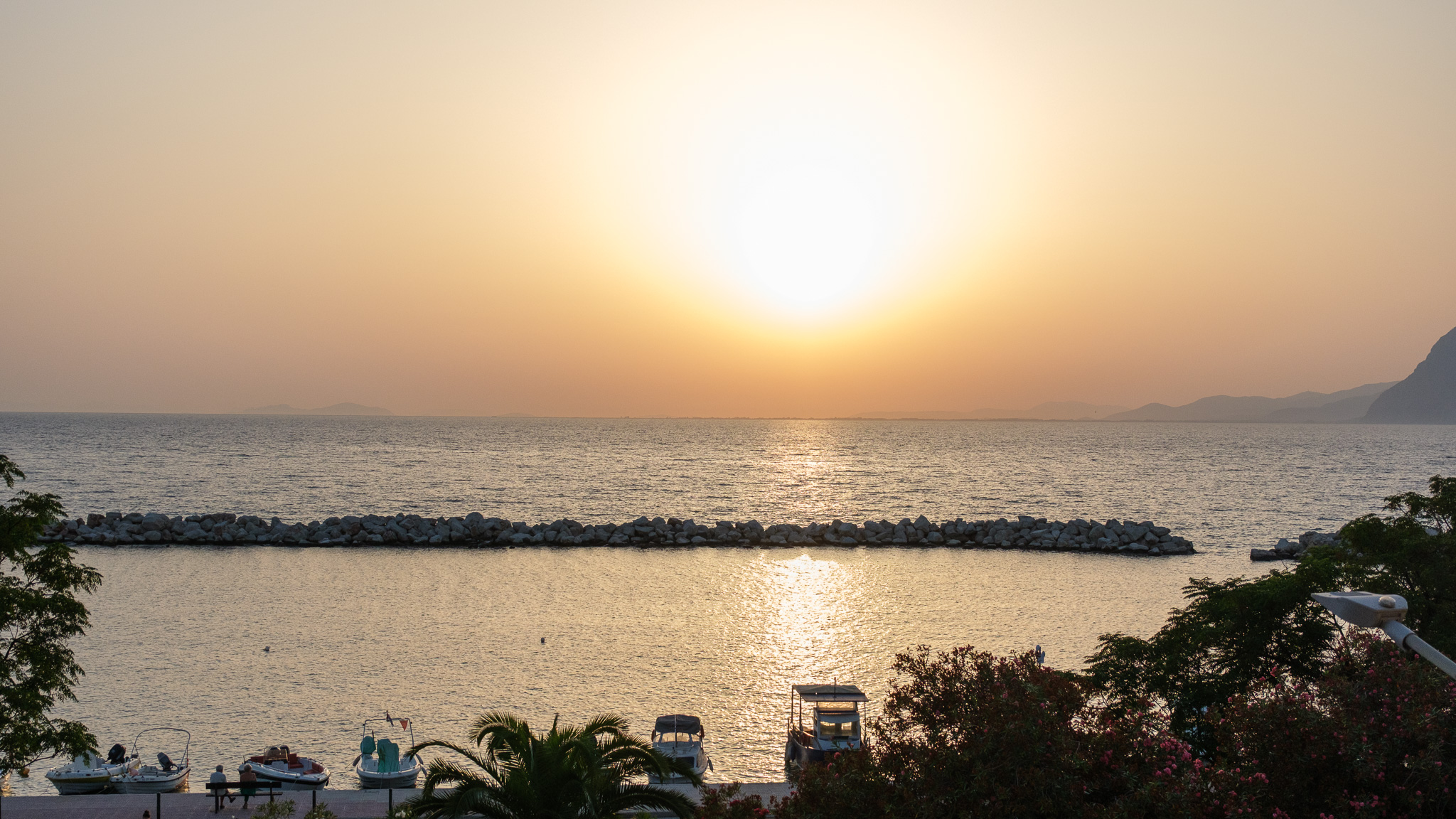
The true heart of Patra remains its waterfront, particularly the bustling Marina area. This stretch of the coastline serves as Greece's perennial gateway to the West, a place where massive ferries chart their way toward the Italian ports of the Adriatic. The Marina is not just a transit point but a vibrant promenade. Locals gather here in the evening to walk along the piers, flanked by the deep blue waters of the Gulf of Patra on one side and the pulse of the city on the other. It is an area defined by the salt air, the rhythmic clanking of boats, and an uninterrupted view of the sun dipping below the horizon.
Situated squarely within this active maritime theater is the Moxy Patra Marina, a hotel that anchors the waterfront with effortless style and this is where I stayed in Patra.
The Moxy
Arriving by car is usually an anxious endeavor in Greek cities, but parking at the Moxy proved painless. The check-in process was handled with a swift, friendly efficiency by the staff, which immediately set a welcoming tone for the stay. The room itself was a triumph of spatial economy. It was as advertised and managed to fit every necessity into its footprint without ever feeling cramped. It was spotless upon arrival and featured an array of modern amenities that worked precisely as they should. The Wi-Fi was fast and reliable, and even the plumbing felt like a comforting piece of home. Being able to use the shower and facilities exactly as you would anywhere else in the world is a subtle but profound relief when traveling.
The true comfort of the space was found in its quiet mechanics. The air-conditioning hummed perfectly, the acoustic insulation blocked the noise of the bustling marina outside, and the blackout blinds created an ideal environment for sleep. The bed was comfortable. When the blinds were drawn open, however, the room offered a stunning vantage point. Watching the sun sink into the sea directly from the window was a highlight. The Moxy Patra Marina is a fantastic hotel that delivers exactly what the modern traveler requires, making a compelling case for lingering a little longer in this dynamic port city.
![[content/images/DSCF1343.jpg]]