
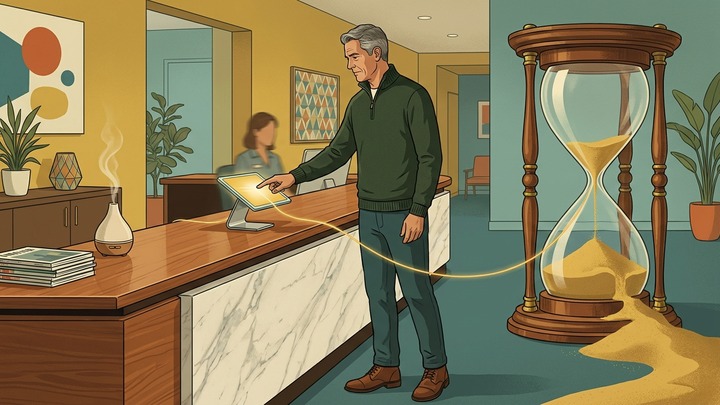
On the reception counter of a suburban dental clinic, nestled between a ceramic diffuser emitting the scent of eucalyptus and a stack of outdated architecture magazines, sits a matte-black tablet held upright by a brushed-aluminium stand. A patient in his early fifties stands before it, rubbing his lower jaw. His dentist has just informed him that four decades of not looking after his teeth have culminated in structural bone loss. The restorative surgery will cost thirty-two thousand dollars. His private health insurance, a mid-tier policy for which he pays more than five hundred dollars a month, will contribute less than two thousand. Seeing the familiar Arithmetic of panic cross the patient’s face, the receptionist does not mention bank loans or payment plans. Instead, she taps the tablet screen to wake it up. "Most people in your position don't touch their savings," she says with practised warmth. "We just use your super."
Across Australia and New Zealand, a quiet liquidation of the future is taking place inside specialist consulting rooms, orthodontic suites, and private surgical hospitals. What began decades ago as a tightly regulated statutory mercy, a provision allowing citizens with terminal illnesses or catastrophic disabilities to access their retirement savings before age sixty, has mutated into a billion-dollar financial pipeline. According to figures from the Australian Taxation Office, early withdrawals of superannuation on compassionate grounds for medical and dental treatment have tripled over the past five years, surging past one billion dollars annually across nearly fifty thousand approved claims. Across the Tasman, where KiwiSaver regulations under the Financial Markets Authority have historically maintained higher barriers for pure medical release, early withdrawals for significant financial hardship have spiked by more than thirty-five per cent year on year, frequently triggered when private surgical bills push middle-class household balance sheets over the brink.
This phenomenon is not occurring among the destitute. Rather, its epicentre is middle-to-higher-income households in their late forties and fifties, a group caught in a peculiar historical vice. Having entered the workforce in the late nineteen-eighties and early nineteen-nineties, these workers missed the early decades of high compulsory retirement contributions. Compulsory superannuation in Australia only began in 1992 at a modest three per cent, while New Zealand's KiwiSaver did not exist until 2007. Their fifties were meant to be the decade of accelerated accumulation, the final runway where peak earnings and compounding interest would repair early-career deficits. Instead, at the precise moment when offset accounts have been drained by years of elevated interest rates and stubborn service inflation, the cost of middle age has arrived.
Raised on high-impact outdoor sports, surf culture, rugby, and unforgiving asphalt running tracks, fifty-somethings are presenting in unprecedented numbers with osteoarthritic knees, herniated lumbar discs, and failing dentition. Dental reconstruction now accounts for nearly forty per cent of all compassionate medical withdrawals from Australian superannuation, followed closely by weight-loss procedures and orthopaedic joint replacements. For a fifty-two-year-old project manager or school principal, spending twenty-four months on a public hospital waiting list in debilitating sciatic pain, or facing client meetings with visibly failing teeth, is not merely an inconvenience. In a corporate culture that prizes vigour and aesthetic preservation while quietly penalising age, physical deterioration is an existential threat to one’s earning capacity.
Yet the mathematics of funding midlife repairs through retirement accounts are unforgiving. When a worker under the age of sixty withdraws money from a superannuation fund on compassionate grounds, the sum does not arrive intact. The government levies a lump-sum withdrawal tax of up to twenty-two per cent. To settle a thirty-thousand-dollar surgical invoice, a patient must actually liquidate more than thirty-eight thousand dollars from their fund.
The deeper wound, however, is the destruction of compounding returns. Modelling by the Association of Superannuation Funds of Australia and the Super Members Council illustrates the gravity of this trade-off. Assuming a standard balanced fund returning seven and a half per cent per annum, removing thirty-eight thousand dollars at age forty-seven does not merely cost thirty-eight thousand dollars; it forfeits twenty years of exponential growth, amputating roughly one hundred and sixty thousand dollars from the individual’s balance at age sixty-seven. Even adjusted for inflation, a single afternoon in a private operating theatre can strip more than a hundred thousand dollars in real purchasing power from a person's seventies and eighties. In a landscape where a comfortable retirement is now estimated to require nearly six hundred thousand dollars for a single homeowner and closer to seven hundred thousand for a couple, two midlife health emergencies can quietly dismantle decades of fiscal discipline.
How did diligent, privately insured taxpayers find themselves raiding their own old-age security to pay for hip replacements and dental implants? The answer lies in the widening chasm between statutory medical rebates and commercial reality. Over the past decade, decades of sluggish indexation in the the Government Benefits Schedules have decoupled public subsidies from the fees charged by private surgeons and anaesthetists. Meanwhile, private health insurers have partitioned their products into rigid tiers. Many households who sensibly downgraded from top-tier Gold policies to Silver or Bronze during recent cost-of-living squeezes discover too late that joint replacements and spinal fusions have been excluded from their cover, or that they still face out-of-pocket surgical gap fees ranging from ten thousand to twenty-five thousand dollars.
Into this breach has stepped an enterprising cottage industry. Across metropolitan and regional centres, commercial third-party intermediaries and corporate medical brokers now partner directly with dental chains and surgical clinics. For an administrative fee between six hundred and fifteen hundred dollars, these agencies package and fast-track compassionate release applications to the tax office. Under Australian Superannuation Industry Regulations, early release requires certification from two medical practitioners stating that the treatment is necessary to alleviate acute or chronic pain and is not readily available through the public system. Because public adult dental care is strictly means-tested and public orthopaedic waiting lists routinely exceed two years, the phrase "not readily available" has become an open thoroughfare. Almost any middle-class taxpayer in chronic pain legally qualifies to liquidate their retirement.
The ideological battle over this trend reveals a profound philosophical divide regarding the nature of wealth, health, and the state.
On the political left, progressive economists, labour unions, and consumer advocacy groups such as Choice view the surge in medical superannuation withdrawals as a stealth privatisation of universal healthcare. They argue that superannuation was legislated for a singular public purpose: to provide dignified retirement income and alleviate future strain on the taxpayer-funded age pension. Allowing citizens to cannibalise their retirement pots to bypass clogged public hospital queues, progressive critics contend, lets state and federal governments off the hook for chronic hospital underfunding while funnelling hundreds of millions of dollars directly into the bank accounts of corporate dental conglomerates and private specialists. Their prescriptions are structural and regulatory: folding adult dental care into Medicare, imposing strict statutory caps on specialist out-of-pocket fees, and outlawing commercial third-party brokers who profit from coaching anxious patients to drain their savings.
Conversely, conservative policy analysts and free-market think tanks view the matter through the lens of personal sovereignty and human capital. Superannuation, they remind us, is not government money; it is compulsory deferred wages earned by the individual. From a right-leaning economic perspective, forcing a fifty-year-old self-employed tradesperson or professional to endure two years of crippling back pain on a public waitlist while sitting on three hundred thousand dollars of their own locked-up capital is a perverse paternalism. If an early withdrawal of twenty-five thousand dollars allows that worker to undergo immediate spinal decompression, return to full productivity, and continue earning a six-figure salary for another fifteen years, the withdrawal is not an act of fiscal vandalism. It is a rational investment in their primary asset: their own capacity to work. Rather than tightening access to private capital, market-oriented reformers propose making private health insurance premiums tax-deductible, removing bureaucratic barriers to building low-cost day hospitals, and introducing dedicated, tax-advantaged Health Savings Accounts so households can accumulate capital for midlife medical contingencies without disturbing core pension assets.
Policy thinkers across the political spectrum converge on one point of concern: the total absence of price transparency in the private medical marketplace. When a patient is offered the frictionless option of tapping a six-figure superannuation balance, normal price sensitivity evaporates. Clinics rarely provide itemised, competitive quotes when the bill is being settled by a distant retirement fund rather than a household bank account.
What would a more rational architecture look like? Independent health economists have begun floating several pragmatic middle-ground solutions. The first is mandatory fee transparency: requiring surgeons, anaesthetists, and dental clinics to register binding, itemised quotes on government cost-comparison portals before the tax office is permitted to authorise a single dollar of superannuation release.
A second, more ambitious proposal involves replacing permanent superannuation withdrawals with an income-contingent medical loan scheme, modelled on the higher-education HECS-HELP system, or allowing members to take a temporary equity loan against their own superannuation balance. Under such a model, a fifty-year-old could draw thirty thousand dollars from their fund to pay for urgent knee surgery, returning to work pain-free, and repay the principal plus a modest notional interest rate back into their own retirement account via automated payroll deductions over the subsequent five years. The patient gets their mobility today; the retirement system retains its compounding integrity for tomorrow.
Until such mechanisms exist, the burden of calculation remains entirely on the individual standing at the reception desk.