August 2026 was a month that felt like more of the same, A war, Economic pressures and another climate event.
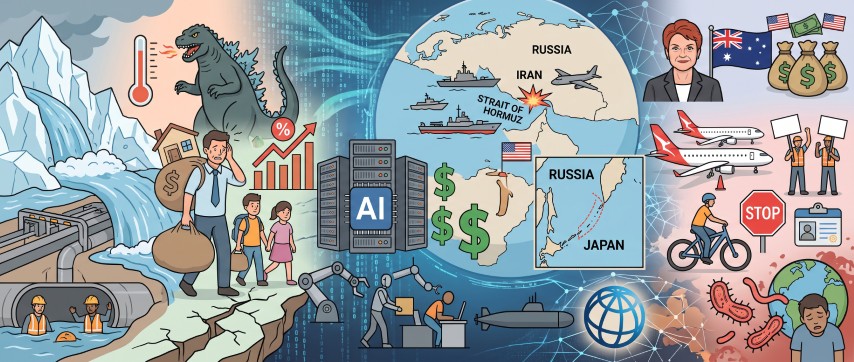
Let us begin with the climate, which is currently undergoing a "Godzilla" El Niño event. The progressive wing of the media is demanding the immediate abolition of fossil fuels as temperatures shatter records, while the conservative press warns that green mandates will merely bankrupt the working class. This supercharged weather system reportedly triggered a catastrophic glacier collapse and flooding along the Nepal-China border, leaving hundreds of hydropower workers trapped in tunnels. The international response was swift but highly politicized. Left-leaning outlets condemned the geopolitical gatekeeping of humanitarian aid by Nepal, while right-wing commentators grumbled about American tax dollars being spent in China's sphere of influence. The Australian media, predictably, united to launch a massive charity appeal.
Economists have confirmed what most of us already knew. With middle-aged adults trapped carrying mortgages into their sixties and funding the basic survival of two other generations, this demographic is running on fumes. The left blames corporate greed and a long-term freeze on worker pay, whereas the right points the finger squarely at sticky inflation caused by government overspending and restrictive zoning laws. To make matters worse, central banks are forced to keep global interest rates high, driven in part by the artificial intelligence boom and Middle Eastern energy shocks. For heavily indebted property owners, these prolonged high rates act as a relentless tax on sanity.
Speaking of artificial intelligence, the tech sector is enjoying a three-trillion-dollar infrastructure boom, highlighted by the enormous valuation of the Anthropic IPO. Conservative media celebrates this as a triumph of free-market innovation. Progressive outlets, however, are panicking over the massive energy consumption of data centers and the imminent threat of AI-driven unemployment. For seasoned white-collar professionals, the AI boom is a double-edged sword. It might briefly inflate their index funds, but it also threatens to automate middle-management jobs before those same professionals can safely retire.
If the economy is frustrating, global geopolitics is actively frightening. The United States and Iran recently re-engaged in direct military strikes in the Strait of Hormuz. Right-wing pundits praised the American strikes as a necessary reassertion of deterrence against Iranian aggression. Left-wing analysts warned that this manufactured escalation threatens to trigger a regional war and spike global oil prices. On top of this, Vladimir Putin decided to take a stroll through the disputed Kuril Islands, outraging Japan. Conservatives used the incident to demand increased naval spending in the Pacific, while progressives dismissed it as a domestic distraction tactic by an isolated despot.
Financial institutions are also shifting. The World Bank announced it will cease non-subsidised loans to China by 2031. The right applauded the move, arguing that Western institutions should not subsidise an adversary, while the left expressed hope that the funds will now flow to genuinely impoverished nations in the Global South. Back in Australia, the government downgraded its ambitious AUKUS pact, opting to buy second-hand Virginia-class nuclear submarines instead of new ones to save cash. Conservative voices complained about the strategic weakness of relying on an overstretched American industrial base, while progressive critics celebrated the cost savings and demanded the money be redirected to domestic housing.
Domestically, the political landscape is fracturing. In Australia, the economic misery of the middle class has fueled a massive polling surge for Pauline Hanson's populist One Nation party. Left-leaning publications view this rise as a dangerous mainstreaming of xenophobia and climate denialism, but the right recognises it as a symptom of legitimate voter fury over housing and immigration. Across the Pacific, American progressives are experiencing their own political outrage, loudly condemning billionaires for funnelling hundreds of millions of dollars into Super PACs to influence the presidential election. They demand a wealth tax and public campaign funding, while conservatives fiercely defend unlimited spending as a fundamental right of free speech.
On the labour front, Qantas ground crews went on strike over a bitter pay dispute. Progressive commentators championed the workers as heroes fighting back against grotesque corporate profits, while the conservative press condemned the union for extorting the traveling public and fuelling inflation.
If there is one piece of news that actually pleased risk-averse suburb dwellers, it was Queensland's crackdown on e-bikes and e-scooters. The new laws ban children under sixteen from riding them and require adult riders to hold a valid driver's license. Environmentalists and progressive urban planners complained that the laws criminalize micro-mobility and keep cities dependent on cars. The right praised the restoration of basic law and order to the sidewalks.
Finally, the World Health Organization reported a fast-growing, mutated strain of Ebola spreading in the Democratic Republic of the Congo. The left demanded immediate global health equity and vaccine distribution, while the right called for strict international travel bans. For a generation still exhausted by the last pandemic, the prospect of another global virus is simply too much to process. They will just have to add it to the tab.