February 2026 bought with it the usual barrage of financial stress and political drama. The news cycle currently feels less like information and more like a targeted assault on the retirement timeline.
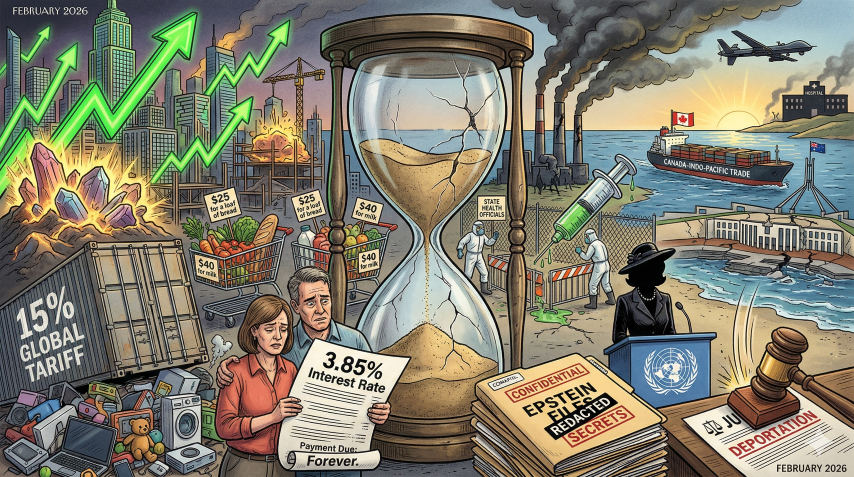
Let us begin with the economy, which remains a masterclass in mixed signals. In the United States, the Trump administration has bypassed a Supreme Court ruling to slap a fifteen percent global tariff on all imported goods. Conservative outlets like Fox News say this as a necessary assertion of executive dominance and a win for American manufacturing. The left-leaning press, naturally, views it as an inflationary and reckless overreach. The framing really is irrelevant. What matters is the reality of a regressive tax inflating the cost of consumer goods, actively vaporizing whatever discretionary income was supposed to be funneled elsewhere.
Meanwhile, the Reserve Bank of Australia decided that a 3.85 percent cash rate was exactly what the public needed to build character. Right-wing commentators at Sky News and The Australian have laid the blame squarely on the Albanese government, they argue that public spending forced the central bank to punish us. Progressive outlets are busy profiling families being suffocated by mortgage stress. The grand plan to eliminate housing debt before retirement is currently being held hostage by monetary policy.
And yet, the very same financial architecture punishing at the checkout and the bank is rewarding the stock market. Against all odds, the ASX 200 just enjoyed its best February since 2019, surging 3.5 percent on the back of strong corporate earnings. The political right views this as a triumph of the private sector, while the left points to it as glaring evidence of a broken and unequal economy. But having diligently fed superannuation accounts for decades, there is quiet enjoyment of the massive, passive wealth expansion. A similar duality exists regarding the astounding profits reported by supermarket giants Coles and Woolworths. Progressive voices demand government intervention against corporate price gouging, while conservative analysts praise supply chain efficiency. The grocery bill is a bitter pill, but the robust dividend yields are helping those with stock portfolios.
In United States domestic politics Bill and Hillary Clinton were hauled before a congressional committee to testify behind closed doors about their ties to the late Jeffrey Epstein. Conservative media treats this as a long-overdue reckoning for corrupt political elites. Left-wing outlets taking Hillary Clinton's lead are dismissing it all as a political theatre designed to distract the public from Donald Trump's own connections to him. Having watched these exact scandals play out decades ago, this revival simply hardens an already robust distrust.
Speaking of the White House, First Lady Melania Trump has taken the unheard of step of chairing a session of the United Nations Security Council. Right-leaning networks applaud her focus on children in conflict zones as a brilliant use of soft diplomacy. Left-leaning commentators condemn this as an inappropriate lessening of diplomatic etiquette. After thirty years spent climbing the corporate ladder based on actual credentials, putting unelected family members into these types of position insults the concept of people being rewarded for their abilities and achievements.
The rules in the United states continue to show they are all over the place. The Environmental Protection Agency (EPA) has cancelled the Biden Mercury and Air Toxics Standards. Conservatives celebrate the move as a victory for grid reliability and affordable energy. Environmental and public health groups warn of a harmful rise in cancer and neurotoxic damage to children. At the same time a major measles outbreak has triggered a revolt among the US state health departments. Following the Centres for Disease Control and Prevention (CDC)'s decision to heavily reduce childhood vaccine recommendations, some states are separating themselves from the federal directions to follow what many would say global medical standards, while other states think this is a shift toward medical freedom. A broken public health direction and the rebirth of preventable diseases directly threaten our stability and inflates an already heavy caregiving burden for our generation.
Immigration policy in the US remains a mess of legal battles and daily changes. A judge in Massachusetts struck down the Trump administration's policy of deporting asylum seekers to third countries saying that this did not follow due process at all. The left celebrates this as a victory for human rights, while the right condemns the judges as activists trying to prevent border security. Corporate leaders, especially those reliant on migrant labor for supply chains are having to manage the operational headaches caused by this endless legal back and forth.
In Australia, the political situation has its own brand of instability. Following a her horrible polling, Sussan Ley resigned and this allowed Angus Taylor to become the leader of the Liberal party. Conservative media insists this reset is vital to stop the party's electoral death spiral and combat the populist surges. Progressive outlets argue the Coalition remains fundamentally out of touch with modern voters. We who are highly sensitive to tax policies and superannuation regulations find ourselves anxious over the lack of a real unified economic alternative to the current government which is necessary to help both sides of politics.
Internationally, Canadian Prime Minister Mark Carney showed some that there are some glimmers of opportunity amid all this chaos. He went on an Indo-Pacific tour, stopping in India, Australia, and Japan. The American conservative media framed the trip as a futile attempt to bypass the US economy, the left praises Carney for forging middle-power coalitions that could hold against Americans dominance over so many economies. For those negotiating or working for companies in multinational commerce, this change offers a chance to diversify supply chains and mitigate the risks of the new US protectionism. Similarly, a global critical minerals summit in Washington has brought allied nations together to break China's monopoly on rare earth elements. This is viewed this as a national security imperative, whereas others view it through the lens of a green energy transition, currently being ignored as a necessity by others. Professionals in the mining and logistics sectors simply see lucrative contracts and long-term job security.
Finally, the world remains brutally complex, as evidenced by the escalation of the Sudanese civil war, which recently featured dreadful drone strikes on hospitals. Conservative voices in the US and Australia argue against committing resources to peripheral conflicts, while everyone else demand urgent humanitarian intervention. Watching yet another human catastrophe unfold simply deepens that these crises all occuring at the same time will interact with each other to make the overall impact far more severe. It is a blunt reminder of global vulnerability, arriving just while we are trying to figure out if there is enough money to live day-to-day let alone saved to survive the next thirty years.