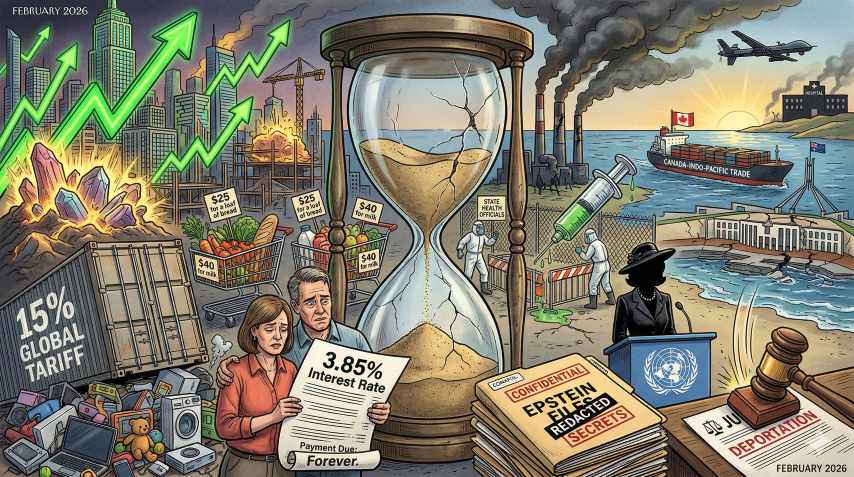
March was a month defined by a compounding global crisis with geopolitical conflict and economic instability. The news cycle has graciously GenX a few more reasons to lie awake at night. Here is a look at the main stories.
The War The month kicked off with the dramatic escalation of the US-Iran war, with a over dramatic name of Operation Epic Fury. Following US military strikes on Iranian Kharg Island, Iran has effectively closed the Strait of Hormuz. The right-wing media immediately framed this as a necessary and decisive display of deterrence, with commentators applauding the restoration of American strength. Conversely, the left-wing press depicted the conflict as a disaster born of imperial overreach, warning of an unwinnable forever war. For those trying to finalize our superannuation portfolios it was not a good month, the resulting global market volatility is alarming. For those of us in the US there also maybe a bit of wondering if their kids will eventually be drafted into a Middle Eastern ground invasion.
Adding a touch of dystopian flair to the military news, sophisticated drone swarms repeatedly breached the restricted airspace of US military installations, including bases housing nuclear bombers. These drones are simple but effective easily resisting advanced electronic jamming. The American right naturally framed this as a catastrophic failure of the previous Biden administration, demanding immense increases in defense spending. Left-leaning outlets pointed out the absurd irony that a perpetually bloated Pentagon budget left the homeland defenseless against cheap commercial tech. For those raised on the grim realities of the Cold War, watching the nuclear triad's defenses bypassed by remote-controlled toys is cause for a little anxiety.
The Economic ouch With the action in the Middle East cutting the flow of oil through the Strait of Hormuz, which is being called by the International Energy Agency the largest supply disruption in the history of the global oil market. Oil prices surged past $100 per barrel. Conservative analysts used the crisis to attack progressive climate policies and demand the immediate deregulation of domestic drilling. Progressive analysts argued the exact opposite, maintaining that the crisis proves the inherent danger of relying on oil and demanding an accelerated transition to electric vehicles.
In Australia, the government panicked. Prime Minister Anthony Albanese announced a temporary halving of the fuel excise tax to offer cost-of-living relief. Right-wing media called the measure a reactionary move that arrived far too late, branding the government incompetent. Left-wing analysts accurately criticized the cut as a populist maneuver and a massive fossil fuel subsidy that virtually guaranteed to trigger further interest rate hikes.
They looked right about the rate increased as The Reserve Bank of Australia looked at the inflationary surge and aggressively raised the cash rate to 4.1 percent. The Australian right blamed excessive government spending and union-friendly wage policies. The left blamed corporate price-gouging in the energy sector and criticized the RBA for punishing mortgage holders. For anyone currently servicing a massive variable-rate mortgage, the math is bleak. Saving a few dollars on the petrol required for the daily school run is entirely eclipsed by losing hundreds of dollars a month to the bank.
No Kings As if the economy was not enough of a headache, an estimated eight to nine million people participated in the third wave of the "No Kings" protests across the United States, Europe, and Australia. The American right dismissed the events as "Hate America Rallies" secretly funded by radical leftist networks. The left celebrated the protests as a monumental defense of democratic norms against authoritarianism. While some of us might theoretically support defending democratic institutions, the reality of paralyzed cities and highway blockades mostly just disrupts already rigid schedules and complex family logistics.
Some could also say we lost a king of martial arts with the passing of icon Chuck Norris which in itself immediately ignited a small culture war. The right memorialized him as a bastion of traditional masculinity, fiercely attacking progressives who critiqued his legacy. Left-wing commentators argued his legacy was permanently tainted by his late-in-life endorsement of far-right politics and conspiracy theories. This just deeply reinforces our fatigue with a political tribalism that infects everything.
The Kids and the Future Perhaps the most sobering news of the month came from the 2026 World Happiness Report. The wellbeing of youth under twenty-five in the US and Australia has plummeted precipitously. Right-wing media blames society's shift away from faith and progressive education systems for stripping the youth of resilience. Left-wing media points the finger at late-stage capitalism and irreversible climate change anxiety. As a parent raising a ten and twelve-year-old in this environment, it is incredibly difficult to avoid a sense of helplessness. We are left shouldering the financial and emotional burden of securing our kids in a world that feels inherently hostile to their future.
And to throw in one final story was the recent revelation that commercially available Artificial Intelligence can now instruct extremists on how to synthesize deadly bioweapons. Right-wing venture capitalists argue against AI regulation so we can win the tech race, while international watchdogs scream for immediate restrictions. Besides protecting company computers from hackers, we now perhaps have to worry about lab-created diseases.
It turns out being GenX in 2026 requires a certain amount of endurance, lets hope April has some better news ahead.