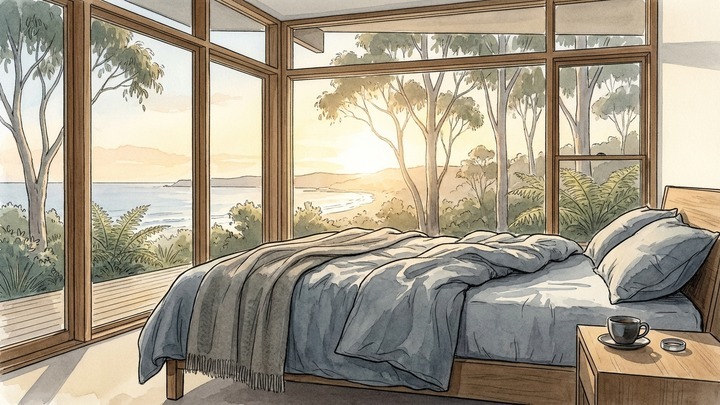
At seventeen minutes past three in the morning, in the quiet bedrooms of our towns and cities, a familiar ritual takes place. The sheets are kicked aside. A hand reaches out from beneath a duvet toward a bedside table, touching a phone screen that blooms with cold blue light, or tapping a titanium smart ring resting against a middle-aged knuckle. The sleeper is wide awake. Their heart beats with a mild, unprovoked urgency. In their mind, a grim internal audit has already begun: four hours and twenty minutes banked, three hours and forty minutes to go before the alarm, and a dwindling statistical chance of salvaging tomorrow's sharpness.
Never in modern history have middle-to-higher-income Australians and New Zealanders paid so much attention, or spent so much money, on the act of going to bed. According to PwC Australia’s 2026 Voice of the Consumer Survey, everyday preventive health has overtaken almost every other discretionary category among affluent households, with sleep optimisation sitting alongside metabolic fitness as a primary longevity pursuit. Bedrooms in suburbs like Toorak, Double Bay, and Remuera are increasingly fitted out like high-altitude training camps, complete with hydro-cooled mattress toppers, mouth tape, magnesium bisglycinate tinctures, and wrist-worn accelerometers.
Yet the harder we pursue the modern gold standard of eight unbroken hours of sleep, the further it seems to recede. Data from the Sleep Health Foundation Australia and the Australian Institute of Health and Welfare indicate that nearly forty per cent of adults between forty-five and sixty experience inadequate sleep duration or poor sleep quality at least three nights a week. The annual economic toll in Australia alone has reached an estimated 66.3 billion dollars in healthcare expenses, lost productivity, and diminished wellbeing. Across the Tasman, longitudinal data from Massey University’s Sleep/Wake Research Centre reveals a mirror image, with over a third of adults in the same bracket falling short of traditional guidelines.
For the past decade, popular science books, most notably the neuroscientist Matthew Walker’s bestseller Why We Sleep, did remarkable work in alerting the public to the dangers of chronic exhaustion. However, they also left a rigid benchmark in the cultural imagination: sleep eight consolidated hours a night, or court early cardiovascular ruin and cognitive decline. When conscientious, high-performing adults treat an arbitrary eight-hour block as a nightly pass-or-fail examination, the pressure to perform triggers the sympathetic nervous system. Sleep clinicians have a name for this condition. In a paper published in the Journal of Clinical Sleep Medicine, researchers led by Kelly Baron coined the term "orthosomnia" to describe insomnia caused directly by the perfectionist quest for ideal sleep metrics on consumer wearables.
Now, chronobiologists and preventive health researchers at institutions like Monash University, Flinders University, and the University of Otago are quietly dismantling the eight-hour ideology. Their findings suggest that for people in their late forties and fifties, measuring recovery purely by uninterrupted nightly sleep duration is biologically flawed. Instead, modern sleep science is shifting its focus from quantity to the broader architecture of deep rest.
To understand why the eight-hour rule breaks down in midlife, one must first look at the history and biology of human slumber. The expectation that we should fall unconscious at ten in the evening and wake up unchanged at six in the morning is a relatively recent industrial invention. Research by the historian Roger Ekirch demonstrated that before widespread artificial lighting, Western populations routinely practiced biphasic sleep. People slept in two distinct four-hour shifts, known as a "first sleep" and a "second sleep," divided by an hour or two of quiet midnight wakefulness used for reading, reflection, prayer, or conversing with a partner in the dark. Similarly, the evolutionary anthropologist David Samson and the UCLA researcher Jerome Siegel studied pre-industrial societies in Tanzania, Namibia, and Bolivia. These groups averaged between 5.7 and 7.1 hours of sleep per night, rarely hitting eight hours, yet they exhibited almost no clinical insomnia and had good cardiovascular health. Waking in the dead of night was not a problem, it was simply what human mammals did.
In our late forties and fifties, this natural inclination toward lighter, more segmented sleep becomes pronounced due to structural changes in the brain and endocrine system. Polysomnography studies show that as we move through midlife, subtle age-related changes in the prefrontal cortex and the suprachiasmatic nucleus, the brain's master clock, reduce the amplitude of slow-wave delta sleep by twenty to forty per cent. Sleep becomes naturally more fragile.
Roughly half of all women going through menopause find their nights fractured, according to the Australasian Menopause Society. The underlying cause is largely a matter of vanishing hormones. Progesterone normally acts as a natural sedative. When it drops, and estrogen levels begin to swing, the brain loses its tight control over body temperature. A nearly imperceptible rise in core heat is all it takes to release a sudden rush of adrenaline and cortisol, abruptly waking a woman at three in the morning. Men in middle age experience a different sort of unraveling. As their testosterone and growth hormone levels slowly drift downward, a frustrating cycle begins. Their sleep naturally becomes lighter, which further dampens hormone production, while softening muscles in the throat quietly pave the way for snoring and sleep apnea.
Compounding this biology is a distinct social geometry. People in their late forties and fifties currently occupy the leadership tier of the regional workforce, serving as law firm partners, medical specialists, company directors, and senior managers during a period of intense corporate restructuring. At the same time, they are caught in a generational vice. Downward, they are supporting teenagers through high-stakes VCE, HSC, or NCEA exams, and housing young adults who cannot afford to rent, they are deciphering the complexities of Aged Care for parents in their eighties. With all this the nervous system rarely gets clearance to land.
How society should resolve this exhaustion has reveals ideological differences. On the left, public health sociologists and trade unions argue that midlife sleeplessness is fundamentally an occupational injury inflicted by twenty-four-hour digital capitalism and unpaid domestic caregiving. Proponents of this view point to Australia’s Right to Disconnect laws, enacted under the Fair Work Legislation Amendment in August of 2024, which granted employees the statutory right to ignore unreasonable out-of-hours messages from their bosses. Two years into the policy, union advocates, including the New Zealand Council of Trade Unions, contend that without firm legislative fences around the workday, individual wellness routines are merely band-aids on a structural wound.
Conversely, right-leaning commentators, preventive medicine entrepreneurs, and performance coaches view sleep architecture primarily through the lens of personal agency and biological literacy. They note with dry realism that no Act of Parliament can stop a fifty-two-year-old executive from pouring two large glasses of Pinot Noir or Shiraz at eight in the evening, or scrolling through property listings in bed at eleven. From this perspective, the explosion of private longevity clinics and biofeedback tools is a triumph of market innovation, handing individuals the clinical data required to govern their own physiology rather than waiting for state intervention.
Both perspectives capture half of the room. An email from a managing director at ten at night and a second glass of Sauvignon Blanc have remarkably similar effects on heart-rate variability. The alcohol acts as a temporary sedative, hastening the onset of light sleep, but as the liver processes ethanol into acetaldehyde three hours later, it triggers a sympathetic rebound that shreds REM sleep and elevates resting heart rate by four to seven beats per minute. When the sleeper checks their wearable app at dawn and sees a readiness score of fifty-two glowing in warning red, the psychological nocebo effect ensures they feel dreadful before their feet even touch the floor.
If chasing eight unbroken hours is a fool's errand, what does the new science of preventive rest recommend instead? The answer lies in trading nightly duration anxiety for a twenty-four-hour portfolio of nervous system recovery.
First, consistency trumps volume. A landmark prospective study of more than sixty thousand UK Biobank participants, led by Associate Professor Angus Burns and researchers affiliated with Monash University and Flinders University, analysed over ten million hours of accelerometer data to compare sleep duration against sleep regularity. Their findings, published in the journal SLEEP, were striking: individuals who went to bed and woke up within a consistent thirty-to-forty-five-minute window each day had a twenty to forty-eight per cent lower risk of all-cause mortality, and up to a thirty-nine per cent lower risk of cardiometabolic death, than irregular sleepers, even when their total hours were shorter. Anchoring your wake time and stepping outside within an hour of dawn to catch ten thousand lux of natural light, even beneath grey Tasman skies, stimulates specialised retinal cells that set an internal timer for melatonin release fourteen to sixteen hours later.
Second, what happens during the first third of the night matters far more than whether you wake briefly at three in the morning. During deep slow-wave sleep, the brain's glymphatic system, a waste-clearance pathway discovered by Dr Maiken Nedergaard, flushes out metabolic debris including beta-amyloid and tau proteins. Because slow-wave sleep requires our core body temperature to drop by roughly one degree Celsius, simple thermal habits yield disproportionate rewards. Taking a warm shower an hour before bed dilates peripheral blood vessels in the hands and feet, allowing core heat to escape rapidly once you slip into a cool bedroom kept between sixteen and eighteen degrees.
What we do in the living room before bed is equally potent. A fascinating 2024 randomised crossover trial at the University of Otago, led by Jennifer Gale and Dr Meredith Peddie, found that when adults broke up four hours of evening sitting with just three minutes of simple bodyweight movements, such as chair squats, calf raises, and standing knee raises, every half hour, they slept an average of twenty-seven to thirty minutes longer that night without any delay in falling asleep. Gentle muscular contraction clears post-dinner glucose and triglycerides from the bloodstream, preparing the metabolic ground for deep rest.
Finally, modern neurobiology is reviving the lost art of waking rest. When a night is inevitably fractured by a hot flush, a teenager's late key in the front door, or a midnight briefing with Frankfurt, the damage can be significantly offset the following afternoon through Non-Sleep Deep Rest (NSDR), an adaptation of the ancient practice of Yoga Nidra championed by the Stanford neurobiologist Dr Andrew Huberman. In a famous positron emission tomography study at the Kennedy Institute in Copenhagen, researchers led by Troels Kjaer found that twenty minutes of motionless, guided body-scan relaxation shifted the brain into restorative alpha and theta waves and increased endogenous dopamine release in the striatum by sixty-five per cent. Lying flat on an office floor or sofa for fifteen minutes after lunch does not replace sleep, but it switches the autonomic nervous system from sympathetic fight-or-flight back into parasympathetic repair.
Looking well and thinking clearly in our fifties does not require winning a nightly wrestling match with a smart ring. It requires understanding that the midlife brain is wired for rhythm rather than marathon unconsciousness. When you wake in the dark at three, leave the phone face down. Keep the room cool, let the mind wander without panic as our ancestors did between their first and second sleeps, and trust that rest is built across the whole of the day.