
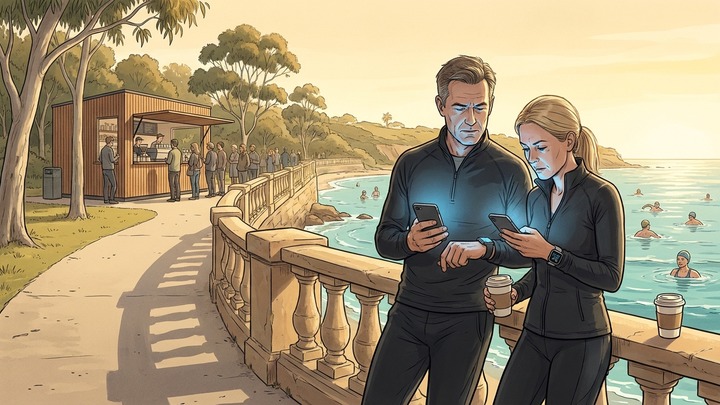
When international lifestyle magazines and urban consultancies release their tables of the world's happiest and most liveable cities, Australian capitals routinely are listed at or near the top. Seven Australian cities recently secured prominent places on a major global happiness index for twenty twenty-six, praised for their abundant sunshine, pristine bushland and coastal access, culinary sophistication, and public safety. On paper, and through the lens of a visiting urbanist, the Australian cities represent the pinnacle of human settlement. Beneath this shiny exterior, however, lies an anomaly that sociologists call the Happiest City Paradox. Long-term national data tracking Australian households reveals a sharp U-shaped curve in life satisfaction. Personal wellbeing hits its absolute statistical floor in midlife, reaching a low point right around forty-eight. Gen X citizens who finance, manage, and inhabit these cities report the lowest satisfaction with their free time of any age group, coupled with peak rates of psychological fatigue.
The discrepancy exists because global liveability indices measure the stage set rather than the play. Rankings reward ideal infrastructure: low violent crime, clean water, green space per capita, and a vibrant cafe economy. They do not measure cognitive load, nor do they capture the peculiar friction of what psychologists might term sunshine guilt. When you live in a subtropical or coastal city that constantly broadcasts an ethos of effortless outdoor leisure, spending fifty hours a week inside a climate-controlled office or navigating congested roads between school drop-offs and aged-care facilities breeds a quiet resentment. The glittering harbour or the eucalyptus-lined trail glimpsed through a windscreen stops feeling like a blessing; it begins to feel like a taunt.
For many Gen X Australians, this exhaustion is rarely a matter of material deprivation. It is a crisis of leverage and compression. Central bank distributions show that Gen X households carry some of the highest nominal mortgage balances in the country, having bought into inflated inner property markets to secure proximity to work and reputable schools. Educating two children through the independent secondary school system in a major capital now frequently consumes more than five hundred thousand dollars in after-tax earnings, locking high-earning parents into relentless billable hours. At the same time, delayed childbirth in the early two thousands has collided with extended human longevity to create a triple-layered dependency. A fifty-two-year-old executive is frequently housing twenty-something children who cannot afford to enter the rental market, while simultaneously spending Sunday afternoons dealing with their parents in their eighties.
Longitudinal studies of adult development, alongside Australian quality-of-life data, demonstrate that once a household passes a baseline threshold of material comfort, additional consumption adds virtually nothing to their happiness. What matters is perceived time autonomy and the depth of close relationships. Behavioural research into what scholars call time affluence confirms that individuals who use their financial resources to buy back free hours, or who fiercely guard unallocated time against the creep of status competition, experience markedly higher life satisfaction than those who upgrade their cars or renovate their kitchens.
Escaping the "Happiest City Paradox" does not require moving to a remote coastal hamlet or abandoning a career; it requires shifting from performative living to intentional engagement with the city that is already there. Data consistently show that midlife Australians who participate in structured, non-transactional local groups report up to twenty-two per cent higher life satisfaction than isolated peers earning the same income. The solution to corporate and domestic overload is rarely found in solitary self-optimisation. It is found on a Saturday morning scanning barcodes as a volunteer at a local parkrun, pulling invasive weeds with a neighbourhood bushcare group, getting out to support local musicians or patrolling a beach with a surf life saving club where nobody cares about your job title or your mortgage rate.
At a practical level, reclaiming happiness in our livable cities begins with a ruthless household review. For many in Gen X, the path out of midlife anxiety involves questioning which fixed expenses are genuinely serving the family's wellbeing and which are merely maintaining a postcode's unspoken dress code. It means replacing high-friction, high-cost Saturday night dining with low-stakes neighbourhood hospitality, where friends gather around a backyard table without three weeks of calendar negotiations. Most of all, it requires treating micro-leisure as non-negotiable. Leaving the smartphone on the kitchen bench for forty-five minutes each morning to walk or swim in the ocean without recording the split times on a digital watch transforms the city from a backdrop for productivity back into a place to live. The infrastructure for happiness is already built and paid for we just need to make the most of it with the community around us.