For forty-nine working days, a covert software program called CyberArk sat inside the laptop of an Insurance Australia Group consultant, quietly counting the physical impacts of her fingers against the plastic keys. When the insurer dismissed her and the dispute reached the Fair Work Commission, the company submitted evidence that on certain days in her home study she had averaged merely five hundred and forty keystrokes an hour. The tribunal upheld the firing on broader performance grounds, yet the revelation sent a distinct chill through the professional class. The modern corporation was no longer merely reading the reports its experienced staff produced; it was counting the taps of their fingers.
What began during the pandemic lockdowns as crude digital oversight has matured into a pervasive automated workplace monitoring. According to technology analysts at Gartner, more than sixty per cent of large enterprises now deploy some form of tracking software. Only about fifteen to twenty per cent use overt spyware that captures continuous screenshots or webcam feeds, through programs with brisk, utilitarian names like Teramind, Hubstaff, and ActivTrak. Far more common, reaching past seventy-five per cent of major firms, is the quiet activation of analytics built into everyday corporate software: Microsoft Viva Insights, Salesforce activity trackers, and Slack logs. These tools do not simply ask whether an employee is sitting at a desk. They attempt to measure how quickly professionals digest information, how rapidly they reply to internal messages, and even, through language-scanning programs, how cheerfully they feel about their managers.
This machinery has collided directly with the lived reality of the people who actually run the white-collar economy. Now in their mid-forties to early sixties, these senior legal counsel, principal engineers, clinical leads, and division directors came of age in the late eighties and nineties under an unspoken social contract. One remembered the heavy clack of an IBM ThinkPad keyboard, the magnetic In-and-Out board beside the reception desk, and the freedom of walking out for a long Friday lunch when nobody knew where you were until Monday morning. You endured the long hours of the junior grind, survived the dot-com crash and the global financial crisis, and in mid-life earned the currency that mattered most: cognitive autonomy. You were judged on whether the merger closed, the bridge stood, or the books balanced, not on whether your status light on a monitor remained emerald green at two in the afternoon.
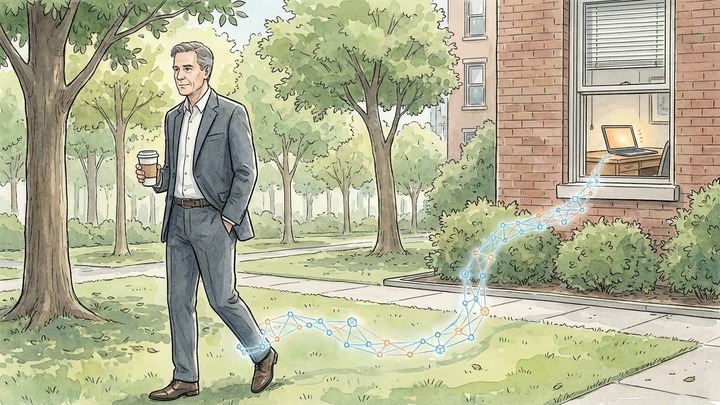
The friction between fifty-year-old expertise and modern tracking software lies in the messy, indirect nature of senior work. When a veteran policy advisor or commercial partner untangles a regulatory deadlock that has stalled a fifty-million-dollar project, the breakthrough rarely happens while hammering uninterrupted prose into a word processor. It happens while walking the dog across a damp park, staring out a rain-streaked window, or spending forty minutes over a flat white in a lobby cafe talking a burnt-out thirty-something analyst out of resigning. A single ten-minute phone call to an old industry contact can save a firm three weeks of due diligence.
To a human peer, that morning represents leadership and the preservation of company talent. To a tracking dashboard, it looks like neglect: zero lines of code committed, minimal mouse velocity, and an unscheduled gap in the calendar. Meanwhile, a junior staffer who spends four hours frantically copying and pasting standard text into a slide deck is rewarded by the software with a glowing productivity score. Observational research confirms this distortion. While electronic monitoring can increase the speed of simple, repetitive tasks like data entry by seven to ten per cent, occupational psychology studies show it reduces performance on complex, creative, and strategic problem-solving by up to twenty-five per cent. By policing the inputs of its highest-paid thinkers, the enterprise actively degrades the very judgment it pays a premium to secure.
Instead of yielding higher output, the algorithmic leash has birthed a flourishing cottage industry of digital theatre. Research by the software firms Qatalog and GitLab found that knowledge workers now spend an average of sixty-seven minutes every day engaging in performative busy: scheduling emails to send at odd hours, making minor, unnecessary edits to shared documents, or keeping status lights green just to feed the telemetry. Professionals with twenty-five years of industry experience and substantial suburban mortgages have been reduced to buying eighteen-dollar mechanical USB turntables online, known as mouse jigglers, simply to keep their cursors in motion while they hang out a load of washing or drive an elderly parent to an afternoon hospital appointment.
This tension has been heightened by two recent shifts in the legal landscape. Following the introduction of the right to disconnect under federal workplace laws, which granted staff the legal backing to ignore unreasonable after-hours messages, a quiet corporate reaction set in. Deprived of the ability to expect nine-o'clock evening email replies, many mid-tier and enterprise employers intensified daytime digital monitoring to ensure that every contracted hour between nine and five is maximally extracted.
At the same time, work health and safety regulators have elevated psychosocial hazards, specifically low job control and intrusive surveillance, to the same legal standing as physical hazards on a construction site or in a coal mine. The stakes are visible in the human body. Industry reporting from Human Resources Director notes that mentally unhealthy workplaces cost the Australian economy twelve billion dollars annually in lost time and turnover. Mental stress claims have risen by more than thirty-five per cent over the past five years, with the median recovery time stretching past thirty weeks, more than four times longer than for physical injuries. Studies from the University of Sydney Business School show that when workers know an algorithm is evaluating them in ten-minute increments, the sympathetic nervous system locks into a state of chronic vigilance. For professionals over forty-five who carefully track their longevity, this low-grade cortisol drip shows up immediately on the wrist: elevated resting heart rates, suppressed heart-rate variability on their Garmin or Apple watches, and fractured sleep.
Yet the debate over workplace telemetry is not a simple morality play between insensitive executives and aggrieved staff; it reflects a genuine clash between two valid philosophies of modern economic organisation.
From the perspective of labour advocates, unions, and digital rights groups, algorithmic management represents a return to the nineteenth-century factory stopwatch. By breaking professional thought down into micro-inputs, employers strip experienced staff of dignity and turn high-trust careers into digital piecework. Furthermore, natural language processing tools that scan internal messaging channels to generate positivity scores frequently misread the pragmatic, dry, or questioning tone typical of seasoned fifty-year-old professionals as resistance to change. Critics on the left argue that corporations are invading the private dining room while shifting the resulting healthcare costs of mid-career burnout onto the public Medicare system.
Conversely, business peak bodies, corporate directors, and cyber-security executives present a sober case grounded in duty and risk management. In an era of sluggish national labour productivity, boards paying senior staff between two hundred thousand and three hundred and fifty thousand dollars a year have an obligation to shareholders to verify that capital is generating a return. High autonomy cannot mean zero accountability.
For the individual, reclaiming autonomy begins with a quiet audit of one's own hardware. Experienced staff should maintain strict separation between personal and corporate devices, requesting a company handset or using browser-only access rather than installing enterprise management profiles on a personal phone. On a work computer, a quick glance at the system task manager or typing chrome://policy and edge://policy into a browser bar will reveal exactly what background agents and forced extensions an employer has pushed to the machine. Under statutory workplace surveillance rules and federal privacy principles, staff can also politely request a copy of the firm's surveillance policy and any automated scores held in their personnel file.
Day to day, the most effective defence is to translate your leadership style into a language the machine respects. Surveillance algorithms and anxious managers loathe a empty space in a digital calendar. Rather than leaving three hours blank while reviewing a complex brief on paper, practice calendar fencing, blocking out time with explicit, output-oriented labels such as Deep Work: Regulatory Risk Analysis, Deliverable Due Friday. Similarly, when forty-five minutes are spent mentoring a younger colleague or settling a client dispute by phone, put a two-sentence summary into the shared project log immediately afterwards creates an undeniable digital footprint of senior judgment. It is a small, pragmatic concession to the dashboard, allowing the people who keep the firm running to close the laptop, step away from the little green light, and get back to the actual work of thinking.