
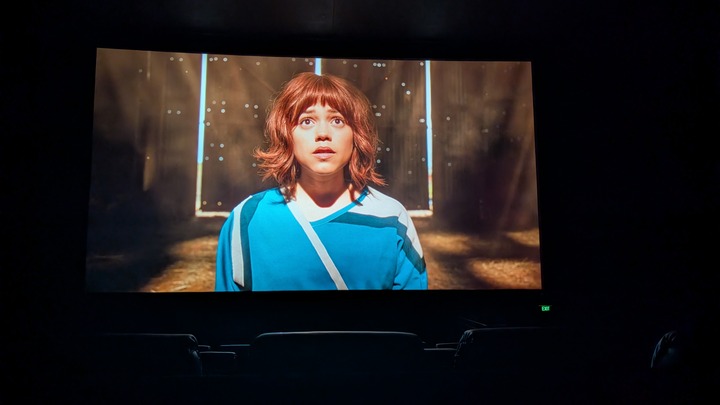
There is a particular chill that settles into the bones inside a Hoyts cinema. One sits in the plush, reclining dark, crossing arms tightly against the chest and wondering why the air-conditioning is set to mimic an Antarctic gale while watching a film entirely obsessed with the warmth of the sun.
The film in question is Klara and the Sun, directed by Taika Waititi and adapted by Dahvi Waller from Kazuo Ishiguro’s celebrated novel. Waititi, born in nineteen-seventy-five, brings a Generation X balanced sensibility to this dystopian science-fiction drama. Produced by David Heyman, Garrett Basch, and Waititi himself, the story follows Klara, an Artificial Friend designed to cure the epidemic of loneliness among teenagers.
Waititi uses colour with remarkable cleverness to set the scene. The early chapters in the retail store glow with an amber warmth that slowly bleeds into cooler, sterile tones as the narrative moves into the wider world. Filmed across dramatic, open landscapes alongside intricate studio work, the scenery is both cool and surreal. The rolling hills look slightly too manicured, the skies a fraction too vast, creating a quiet unease.
At the centre of this unsettlingly polite future is Jenna Ortega as Klara. Simply watching the expressions shift across her face is worth the price of admission. She is a leader among her peers at this kind of physical, quiet acting, communicating a machine’s earnest desire to understand human grief through the slight tilt of her head or a fractionally delayed blink. Opposite her is Amy Adams, another proud member of Generation X, who plays Chrissie, the desperate, sharp-edged mother of the ailing teenager Josie, played with fragile grace by Mia Tharia.
The film moves at a deliberate, unhurried pace. It refuses to be predictable, keeping the viewer quietly intrigued about what might happen next without resorting to cheap thrills. Instead, it asks fundamental questions about human relationships. How do you train a friend to be a friend, or more darkly, how do you train a machine to replace a teenager? Waititi and Ishiguro exaggerate human emotions and the clinical purpose of robots in a way that serves the plot while forcing us to consider where our own society is heading. What separates a good robot from a bad one, if both are merely reflecting the desires of their owners?
Beneath the personal drama lies a sharp political question that becomes more relevant by the day. In Klara’s world, children are genetically "lifted" to gain access to higher education and elite society, while the unlifted are left behind. What is the future for the have-nots when education and access to technology become the ultimate difference makers?
Then there is the supporting cast, including Waititi’s fellow countryman Bret McKenzie, who brings a surprisingly unsettling presence to the screen. Who could have thought that a New Zealand accent, usually so disarming and friendly, could be deployed to create such a scary, sinister overtone? It is a clever subversion of expectations. Even the soundtrack offers small, unexpected pleasures; when a Violent Femmes track quietly drifts through the speakers halfway through the story, you cannot help but feel that any movie with the good sense to include them cannot be all bad.
By the time the final credits roll, Klara and the Sun delivers an ending that may not be what a hopeful viewer was wishing for, yet it feels entirely suited to the quiet honesty of the movie. You walk out of the freezing cinema back into the real light with a small, involuntary smile. The lasting thought is simple enough. Do not give up on the people around you, and appreciate what you have while it is still here.