
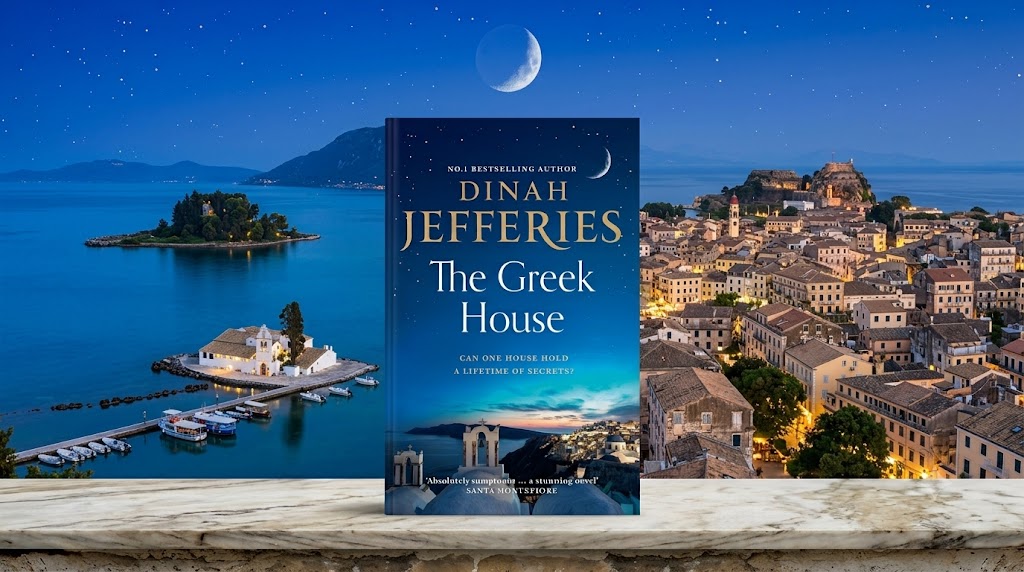
Reading Dinah Jefferies's The Greek House leaves one in a state of mild perplexity. The novel is set primarily in early twentieth-century Corfu, opening against the backdrop of a brief Italian occupation of the island in 1923. It is here that a family is shattered when nine-year-old Billy disappears in the ensuing chaos. The narrative then jumps forward to 1930, following Billy’s sister, Thirza, as she returns to the family estate known as Merchant's House. She arrives hoping to restore the property and salvage her own unravelling life. Jefferies brings a heavy, lived emotional weight to this premise. The author tragically lost her own fourteen-year-old son in 1985, an experience she has often cited as bringing her life to a standstill. This profound grief bleeds into the pages, lending a palpable authenticity to the way her characters navigate the trauma of losing a child.
Yet, despite this emotional undercurrent, the novel struggles to fully transport its reader. The descriptions of Corfu are certainly pleasant. However, they lack the granular detail required to evoke a truly immersive sense of place. I found myself wanting to feel the island, to smell the salt and the dust of that specific era, but the text never quite delivers that depth. It is a good book, but it stops short of being an excellent one because it misses the atmospheric resonance one hopes for in historical fiction.
The narrative architecture itself is a bit uneven. The central mystery is compelling at the outset, but it soon feels as though the author had a brilliant initial concept, padded the middle chapters, and then rushed to tie up the loose ends at the finale. Even the twists, while enjoyable, often telegraph themselves before they arrive. The romantic subplot is similarly perplexing and feels rather peculiar, never quite achieving the level of descriptive intimacy that might have made it convincing.
What anchors the book, however, are its characters. Thirza is particularly well drawn and engaging. The prose is clean and accessible, allowing the story to flow naturally across a span of many years without ever feeling bogged down. The pacing is brisk and keeps the pages turning effortlessly.
Ultimately, The Greek House does not seem interested in imparting any grand, lingering message. While I enjoyed Thirza enough to be intrigued by Jefferies's other works, I suspect my next read will be something different. The novel remains a perfectly fine summer companion. This is especially true for readers who have spent time in the Mediterranean, as their own memories will handily fill in the atmospheric blanks the author leaves behind.