
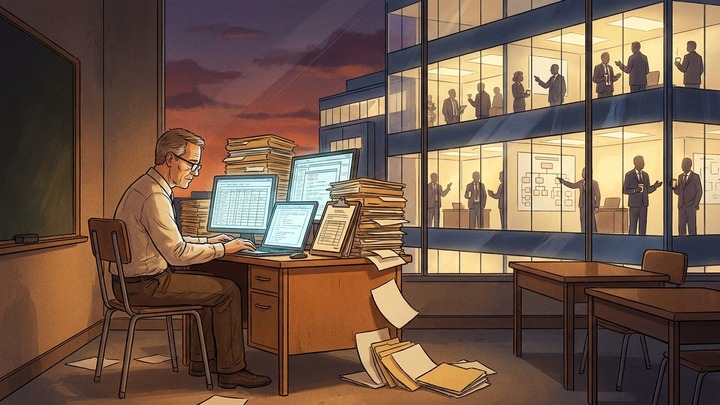
Australia currently spends more money on schooling and employs a larger education workforce than at any point in its history, yet classrooms across the nation remain chronically short-staffed. While billions of additional taxpayer dollars have flowed into education over the past decade, a growing share of that funding has bypassed the teachers whiteboard entirely. Instead, it has driven an expansion of non-teaching personnel, compliance administrators, and duplicated state and federal bureaucracies. The result is an upside-down system where corporate head offices flourish, while veteran classroom educators face rigid salary ceilings and heavy administrative workloads.
Across the country, this imbalance has become the defining feature of modern education. Education spending in Australia has reached historic heights, exceeding eighty-five billion dollars annually in government expenditure. Whenever state premiers or federal ministers are pressed on declining literacy rates or classroom shortages, they point to record funding injections and unprecedented headcounts. Yet for Generation X, the cohort that currently makes up nearly forty-five per cent of the nation's senior educators and principals, while at the same time paying record independent school fees or navigating strained local catchments for their own children, the arithmetic seems flawed. If the nation is employing more education workers and spending more money than at any point in its history, why do classrooms feel forever short-staffed, and where has the money gone?
The answer lies in a silent structural transformation of the Australian education workforce. Over the past decade, the ratio of classroom educators to non-teaching administrative, managerial, and support personnel has shifted dramatically. According to the latest figures from the Australian Bureau of Statistics, Australian schools employ approximately 311,655 full-time equivalent teaching staff alongside 139,122 non-teaching personnel. Roughly thirty-one per cent of the people working inside school gates do not lead the classroom. More telling is the velocity of this change. Over the past ten years, while student enrolments grew by twelve per cent and the teaching workforce expanded by sixteen per cent, the ranks of non-teaching school staff surged by thirty-two per cent, growing at precisely double the rate of classroom educators.
This expansion inside schools is mirrored by a bureaucratic architecture outside them. Under the Australian Constitution, running schools is a state and territory responsibility. Even so, the Federal Department of Education in Canberra employs roughly 1,750 ongoing public servants and consumes an annual departmental operating budget exceeding four hundred million dollars, despite not operating a single school. Its primary function is to negotiate funding agreements, audit state compliance, and oversee national frameworks.
Alongside the federal department sit national statutory authorities such as the Australian Curriculum, Assessment and Reporting Authority and the Australian Institute for Teaching and School Leadership. Each state and territory then replicates this with its own massive corporate head office and statutory boards. New South Wales maintains over 3,500 corporate and regional non-school staff alongside its own standards authority; Victoria and Queensland operate parallel empires of thousands of corporate personnel. Combined, Australia employs more than fourteen thousand state and federal corporate bureaucrats in education outside of schools.
To follow the money through this system is to observe an upside down reward structure, one in which remuneration rises in direct proportion to an employee's physical distance from children. A graduate teacher in Australia begins on a salary between $75,000 and $85,000, depending on the state. After eight to ten years of classroom service, a teacher hits a hard salary ceiling between $113,000 and $122,000. Unless a veteran teacher agrees to abandon the classroom for an administrative sub-principalship or a gruelling accreditation process, a twenty-five-year veteran earns the exact same base salary as a teacher in their early thirties.
In the quiet of the central departments, the financial course looks quite different. Mid-level policy analysts and Executive Level bureaucrats earn between $115,000 and $168,000, buffered by a generous fifteen point four per cent federal superannuation contribution that outstrips the statutory rates paid to state teachers. Senior Executive Service officials draw packages ranging from $220,000 to well over $450,000, while enjoying standard thirty-seven-and-a-half-hour weeks and flexible work-from-home provisions. Across the Organisation for Economic Co-operation and Development, employee compensation typically accounts for roughly seventy-six per cent of current education expenditure, with direct teacher salaries making up around sixty per cent. In Australia, once central departmental overheads, capital charges, and outside agency costs are factored in, direct classroom teacher salaries represent only about fifty-two to fifty-five per cent of the public education dollar.
Why has the non-teaching staff grown so fast? The explanations depend heavily on where one sits on the political spectrum, though both sides are observing the same elephant from different angles.
From the conservative and free-market perspective, advanced by researchers at institutions such as the Centre for Independent Studies, the explosion of non-teaching staff represents a classic case of bureaucratic capture and regulatory bloat. Right-leaning analysts argue that central departments and statutory agencies justify their own existence by inventing perpetual cycles of curriculum revisions, compliance audits, and social policy initiatives. In this view, the expansion of back-office managers creates a bloodsucking feedback loop: every new directorate hired in a state capital requires data, risk matrices, and acquittals from schools to justify its budget, thereby generating the very paperwork that suffocates teachers. Furthermore, free-market critics point to union-enforced, uniform pay scales that compress wages is preventing schools from paying higher salaries to retain gifted maths, science, and literacy teachers, while diverting billions into an unaccountable administrative group of people that have witnessed a twenty-year slide in international academic benchmarks.
Progressive educators, public school advocates, and the Australian Education Union offer a different perspective. From the left-wing perspective, lumping all non-teaching staff under the disparaging banner of bureaucracy misrepresents what is actually happening inside struggling public schools. They point out that the bulk of in-school non-teaching growth consists of learning support officers and teacher aides, who typically earn between $55,000 and $72,000 a year, alongside vital student counsellors and speech therapists. Public schools, they argue, are performing social triage for a society experiencing surging rates of childhood neurodiversity, complex behavioural dysregulation, and intergenerational poverty.
Left-leaning analysts also highlight the sharp divergence between the public and private sectors. According to Productivity Commission breakdowns, high-fee independent schools employ the highest ratio of non-teaching personnel in the country, maintaining roughly one non-teaching staff member for every one point eight teachers, compared to one for every two point three teachers in government schools. In the independent sector, non-teaching growth has been driven by directors of philanthropy, alumni engagement teams, digital marketing specialists, and risk governance officers. Meanwhile, progressive critics argue, public teachers are drowning in compliance precisely because governments have embraced corporate-style auditing, treating educators with distrust while failing to fully fund public schools to the minimum resource standard.
The great irony of this staffing boom is that hiring tens of thousands of administrative and support personnel has failed to liberate teachers to actually teach. According to the OECD Teaching and Learning International Survey and research by the Grattan Institute, Australian teachers work an average of forty-eight to fifty-five hours per week during term time, yet spend less than forty-two per cent of those hours in face-to-face classroom instruction. Australian educators spend between seven and nine hours every week on general administrative work, excursion risk assessments, compliance logging, and parent communication, nearly double the OECD average of four and a half hours.
High-performing international jurisdictions manage their teachers very differently. Countries such as Estonia, Finland, and Singapore maintain significantly leaner central compliance bureaucracies and demand far less administrative reporting from schools. Rather than paying thousands of external auditors to check whether teachers are following processes, those systems invest heavily in rigorous initial teacher training and then grant educators high autonomy, or, in Singapore's case, structured career tracks that reward master classroom teachers with executive-level pay.
To solve this problem, Australian politicians from all sides need to ask tough questions about how the system is set up. Does a nation of twenty-seven million people truly require eight separate state and territory education departments, eight curriculum and registration authorities, a federal department, and two national agencies all governing the same classrooms?
Practical reform does not require firing the teacher aides who keep inclusive classrooms functioning. Instead, it demands a radical reduction of duplicated federal and state corporate hierarchies, redirecting those nine-figure operational budgets back to the classroom. It means deploying modern artificial intelligence tools to automate routine timetabling, risk matrices, and syllabus documentation, rather than using technology to create more surveillance spreadsheets. Above all, it requires breaking the flat salary ceiling by establishing widespread Master Teacher pathways that allow our finest educators to earn $150,000 or $160,000 a year while remaining in the classroom.
Until the system values the person standing in front of thirty restless teenagers more highly than the person auditing a spreadsheet in a capital city, the lights in the staffroom will keep burning late into the evening, and the quiet exodus of our most teachers will continue.