Mid-2026 the world feels less like a traditional progression of historical events and more like a relentless series of small recalibrations.
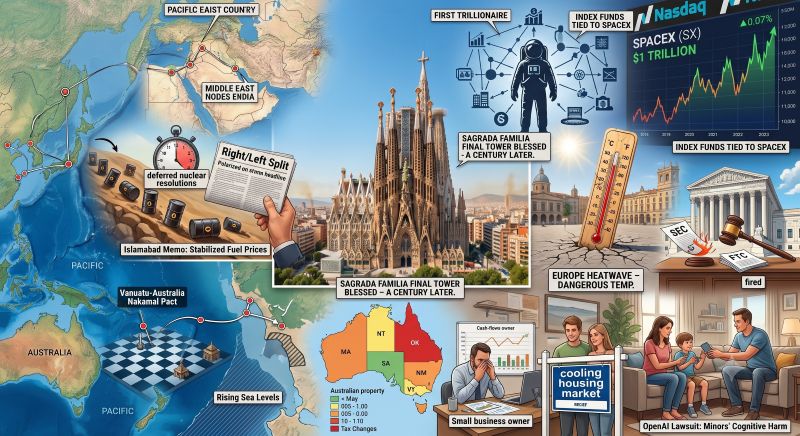
The sudden implementation of the Islamabad Memorandum established a temporary ceasefire between the United States and Iran. The immediate domestic consequence is a welcome stabilization for global energy prices, yet the political interpretation remains entirely polarised. On the right, commentators are treating the truce as a triumph of aggressive military posturing that successfully forced Tehran to yield. On the left, they warn that the three-hundred-billion-dollar reconstruction fund is a fragile, transactional pause that lacks proper oversight and rewards authoritarian behavior. For those watching the headlines, the small relief of cheaper fuel is balanced by the burden of deferred nuclear resolutions, and wondering how long this global pause will actually hold. The chessboard extended to the Pacific with the Vanuatu-Australia Nakamal Agreement, a half-billion-dollar pact designed to block foreign military infrastructure. Right-wing media cheered the strategic containment of regional rivals, while left-wing outlets dismissed it as transactional diplomacy that ignores the immediate existential threat of rising sea levels.
While governments patch up regional conflicts, the financial sector achieved a milestone that few outside the technology sector requested, the arrival of the world's first trillionaire. The historic SpaceX initial public offering on the Nasdaq raised seventy-five billion dollars and pushed Elon Musk's personal net worth into thirteen figures, heavily driven by the integration of his artificial intelligence operations. Conservative business praised the moment as the absolute peak of free-market innovation and personal risk-taking. Progressive publications condemned it as a horrifying example of wealth inequality. The practical complication for mid-career professionals is that SpaceX quickly anchored itself within major index funds, meaning standard retirement accounts are now directly tied to the corporate fortunes of a single aerospace empire. Having already weathered the dot-com crash and the financial crisis of 2008, we will be forced to watch our long-term security ride the waves of billionaire, sorry trillionaires speculation and AI hype.
This corporate unpredictability is further complicated by a shifting American legal landscape. The Supreme Court handed down a decision in Trump v. Slaughter, granting the executive branch absolute authority to fire the heads of independent regulatory agencies like the SEC and FTC at will. The political right welcomed the dismantling of what they describe as an unaccountable bureaucratic state, while the left declared it an autocratic threat to consumer and market protections. For those managing corporate compliance or investment portfolios, the ruling introduces a structural instability, transforming steady regulatory frameworks into divisive policies that could pivot completely every four years.
Australia introduced sweeping overhauls to property taxation and employment rules. The domestic left cheered the limitation of negative gearing and the reduction of capital gains tax discounts, viewing the legislation as a vital strike against systemic housing inequality. The right spitefully opposed the changes, calling them a harsh tax grab that punishes middle-class ambitions and threatens to drive up rents by putting off investors. For established property owners, these reforms disrupt long-term wealth accumulation, though they offer a bittersweet consolation, a cooling housing market might finally allow their children to buy a home without completely draining the family savings. Simultaneously, the July 1 rollout of Payday Super, minimum wage increases, and expanded parental leave has created a distinct internal divide. Salaried workers benefit from the rapid compounding of their retirement funds, but the substantial population of small-to-medium enterprise owners faces a punishing cash-flow squeeze as they adjust to per-payroll superannuation compliance alongside rising operating costs.
Even the cultural and environmental updates offer little peace of mind. Florida launched a first-of-its-kind civil lawsuit against OpenAI, alleging that ChatGPT causes severe cognitive harm and behavioral addiction in minors. Conservative platforms rallied behind the move for confronting Big Tech, while progressive tech writers pointed out the hypocrisy of attacking software algorithms while ignoring the loose physical weapon regulations connected to the case. Parents are left to act as the unpaid digital police in their own living rooms, managing new technologies with minimal support. This digital adoption stands in sharp contrast to the physical realities of a changing climate, as record-breaking European heatwaves and dangerous temperatures at the FIFA World Cup matches forced a public reckoning. While progressive outlets demand immediate reductions in corporate carbon emissions, conservative media warns against aggressive green energy transitions.
Amid this modern craziness, there was a moment of old school persistence in Barcelona, where the final tower of the Sagrada Familia basilica was blessed a century after the death of its architect. Right-wing media celebrated the structural triumph of traditional sacred art, while left-wing commentators focused on local improvement and the displacement of residents. It remains a rare, enduring monument, standing tall in a world where everything else seems to require a software update or a revised tax strategy.